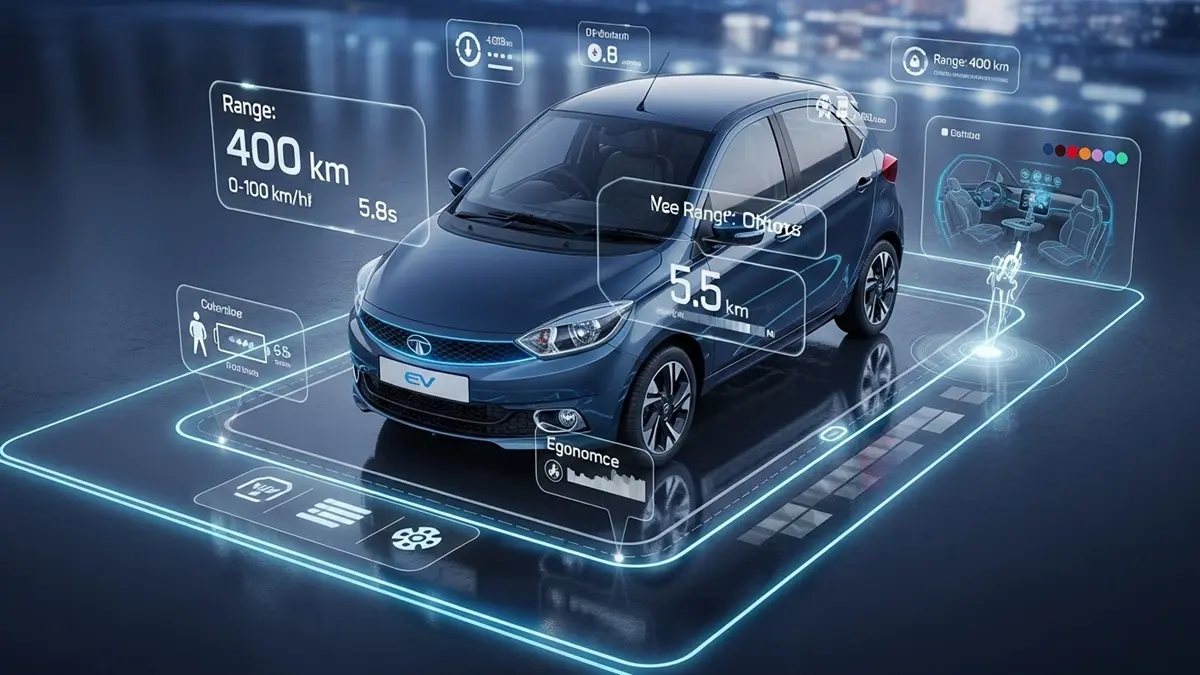
Tata Tiago EV isn’t trying to be a fancy Tesla or a big SUV. It’s the people’s electric car. The one that makes the switch from petrol feel less scary on the wallet. I’ve driven this little hatchback through narrow Delhi lanes, over Bengaluru’s endless speed breakers, and even on a short highway run. And here’s the truth: it has flaws, but for city folks who want to save money without feeling like they’re sitting in a tin can, this thing works.
Design: Small, Smart, and Slightly Sharper Now
The 2025 update gave the Tiago EV a small facelift. You now get a cleaner front end with a bigger air vent, sleek LED headlamps (on top trims), and a black roof that makes it look a bit sportier. The old blue EV highlights are gone – replaced by silver and black bits that look more mature . It’s still a compact hatchback – 3.7 meters long – which means you can squeeze into tight parking spots without sweating. The ground clearance is decent for city roads, though I wouldn’t take it rock crawling.
One small gripe: even the top variant runs on steel wheels with wheel covers, not alloys. But the redesigned covers look neat enough that most people won’t mind .
Performance: Smooth City Rider, Not a Highway Hero
Here’s where the Tiago EV shines – city driving. The electric motor (74bhp and 114Nm on the LR version) gives you instant torque. You know that lag you feel in a petrol car when you press the accelerator? Not here. It zips from 0 to 40km/h effortlessly, making traffic light getaways actually fun . The steering is light, which is great for maneuvering through crowded markets. And because it’s an EV, there’s no engine noise – just a faint whirr.
But don’t expect it to be a highway cruiser. Push it past 80-90km/h, and the energy drops faster than your phone battery on a road trip. The suspension is tuned for comfort – small bumps are absorbed nicely, and even larger potholes don’t feel jarring . Overall, for daily commutes under 50-60km, it’s genuinely enjoyable to drive.
Range & Battery: The Real Numbers You Care About
Tata claims 293km for the Long Range (24kWh) variant on the MIDC test cycle. But real world is different – and I appreciate that owners and testers are honest about it. In mixed city + highway driving, expect around 187-200km on a full charge . With the AC running in summer? That number drops further – some owners report around 150-160km with full AC usage .

The Medium Range (19.2kWh) claims 223km, but real-world will be closer to 140-160km. So if your daily running is over 120km, definitely stretch for the LR version.
Charging times (from 10% to 100%):
- Standard 3.3kW home charger (comes with the car): 8.7 hours for LR, 6.9 hours for MR
- Optional 7.2kW fast AC charger: 3.6 hours for LR, 2.6 hours for MR
- DC fast charger (10-80%): about 58 minutes – great for emergencies
Running cost? About ₹0.82 to ₹0.86 per kilometer if you charge at home at ₹10/unit . That’s roughly one-tenth of what a petrol car costs. Over a year, the savings are serious.
Safety: 4-Star Global NCAP – That’s Solid
This is where Tata usually wins. The Tiago EV has a 4-star Global NCAP safety rating . For a car at this price point, that’s excellent. You get dual front airbags as standard, ABS with EBD, ESP, hill hold assist, and ISOFIX child seat mounts . The body shell is strong – Tata uses high-strength steel, and you feel that when you close the door. It doesn’t feel hollow.
The 2026 facelift (expected soon) might bring six airbags across all variants, but right now, the top variants get two. Still, a 4-star rating at this price is hard to beat. The only missing piece? No rear disc brakes, but drums do the job for city speeds.

✅ Pros
- Low running cost – saves a lot compared to petrol
- Smooth, peppy drive in city traffic
- 4-star Global NCAP safety rating
- Compact size – easy to park and maneuver
- Feature-packed cabin with 10.25-inch screen
❌ Cons
- Real-world range under 200km with AC on
- Not ideal for long highway trips
- Rear seat space is tight for tall adults
- No alloy wheels even on top trims
- DC fast charging not as quick as some rivals
Price Structure (Ex-showroom, Delhi)
The Tiago EV is available in four main variants :
- XE MR (Medium Range): ₹7.99 lakh
- XT MR: ₹8.99 lakh
- XT LR (Long Range): ₹10.14 lakh
- XZ+ Tech LUX LR (with 7.2kW charger): ₹11.14 lakh
On-road prices add about ₹50,000-70,000 depending on your city’s RTO and insurance costs . The top-spec gets the larger 10.25-inch touchscreen, leatherette seats, cooled glovebox, and a better sound system. The base XE is very barebones – no AC? Actually it does have AC, but you miss out on the fancy screen and connected features.
Comparison Table: Tiago EV vs MG Comet vs Citroen eC3
These are the three most affordable electric cars in India right now. Here’s how they stack up:
| Feature | Tata Tiago EV (LR) | MG Comet EV | Citroen eC3 |
|---|---|---|---|
| Price (ex-showroom) | ₹10.14 – ₹11.14 lakh | ₹6.99 – ₹9.83 lakh | ₹12.69 – ₹13.49 lakh |
| Battery size | 24 kWh | 17.3 kWh | 29.2 kWh |
| Claimed range (MIDC) | 293 km | 230 km | 320 km |
| Real-world range (tested) | ~187 km | ~193 km | ~228 km |
| Power | 74 bhp | 42 bhp | 57 bhp |
| Seating capacity | 5 seats | 4 seats | 5 seats |
| Safety rating | 4-star (Global NCAP) | Not tested | 0-star (Global NCAP) |
| Boot space | 240 litres | ~100 litres | 315 litres |
| Best for | Families who want safety + 5 seats + low running cost | City couples / solo drivers wanting smallest footprint | Those who prioritize boot space and don’t mind lower safety rating |
Which one should you pick? If you have a family (even a small one) and safety is non-negotiable, the Tiago EV is the smarter choice. The Comet is smaller, cheaper, but only seats four. The eC3 gives you more range and boot space, but that 0-star safety rating is hard to ignore. For most Indian middle-class families, the Tiago EV hits the sweet spot between price, safety, and practicality.

Frequently Asked Questions
A: It is a fully electric hatchback. No petrol or diesel option. Tata also sells a regular petrol Tiago, but the Tiago EV runs only on battery power.
A: Expect around 160-190km on the Long Range variant with AC running in summer. Without AC, you might touch 200-210km .
A: With the standard 3.3kW charger, about 8.5 to 9 hours for the LR variant. Overnight charging works perfectly .
A: Yes. It has a 4-star Global NCAP rating, dual airbags, ABS, ESP, and ISOFIX mounts. That’s very good for this price segment .
A: Not really recommended. The real range is under 200km, and DC fast charging takes nearly an hour. It’s best as a city car – for daily commutes, school runs, and local errands.

A: Very low. No engine oil changes, no spark plugs, fewer moving parts. Owners report that service costs are roughly half of a petrol car .