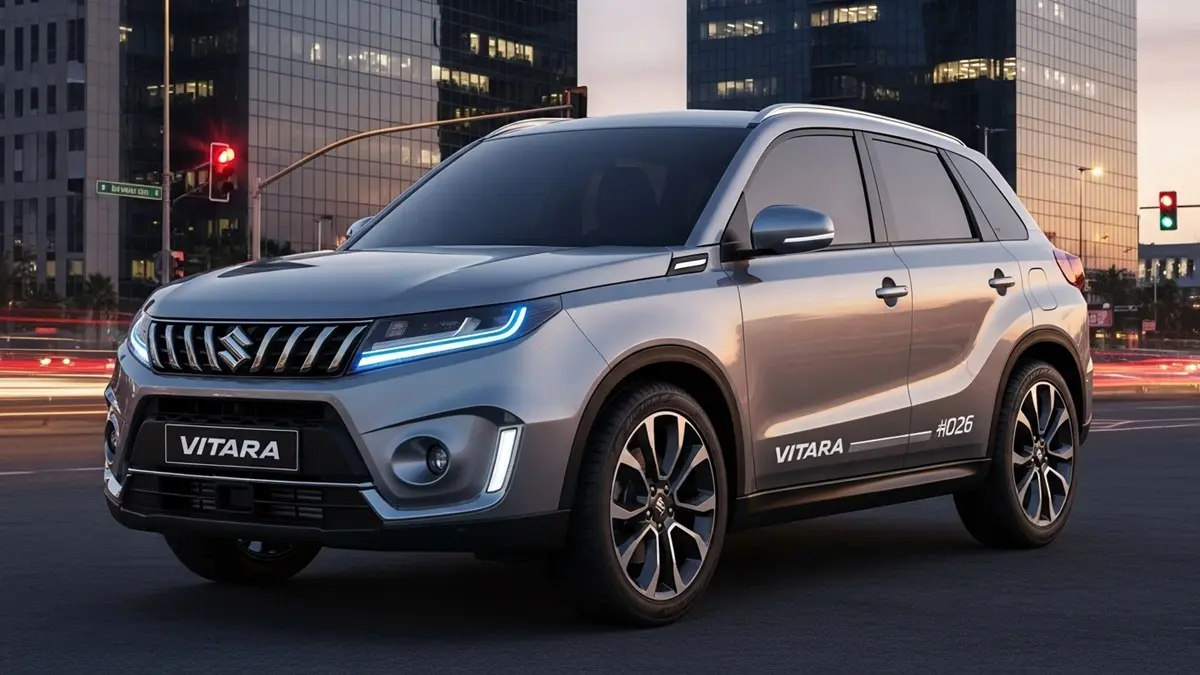
After what felt like an eternity, Maruti Suzuki has finally entered the electric game. The e Vitara isn’t just another EV — it’s the carmaker’s first-ever electric vehicle, built on a brand new platform, and it’s already making waves. Bookings are open for a token of Rs 21,000 at Nexa dealerships, and deliveries are set to begin in phases .
I’ve had a chance to drive the e Vitara through city traffic and on open highways. The question on every buyer’s mind is simple: Is this the EV that finally makes Maruti loyalists switch to electric? Let me break down everything you need to know — the good, the bad, and the honest truth.
Design: A Proper SUV That Turns Heads
The e Vitara looks nothing like Maruti’s usual fare. It’s aggressive, muscular, and has real road presence. At the front, you get a closed-off grille (typical for EVs) flanked by sharp LED headlamps with Y-shaped DRLs that give it a distinctive identity . The lower bumper gets chunky skid plates, and the charging port sits neatly on the front flank .
Moving to the side, the e Vitara measures 4,275mm in length, 1,800mm in width, and 1,635mm in height, with a generous 2,700mm wheelbase . That long wheelbase translates directly into rear legroom — more on that later. The 18-inch aero-efficient alloy wheels with aerodynamic inserts look smart, and the prominent bulge over the rear wheel arch adds to the muscular stance .
At the rear, you get connected LED taillights, an integrated roof spoiler, and a faux skid plate. Ground clearance is 180-185mm, which is decent for Indian roads .
One thing to note — the rear door handles are placed on the C-pillar, similar to the old Honda Civic. It looks neat but takes some getting used to .
Interior: Maruti’s Most Premium Cabin Yet
Step inside the e Vitara, and you’ll immediately notice that Maruti has stepped up its game. The dashboard is asymmetric and uses soft-touch materials that feel genuinely premium . The floating dual-screen setup — a 10.25-inch digital instrument cluster and a 10.1-inch touchscreen infotainment system — dominates the cabin .
Physical controls for AC and volume are still present, which is a blessing. Maruti could have gone the all-touchscreen route, but they didn’t. Thank you for that.
Key interior features include :
- Wireless Android Auto and Apple CarPlay on the Delta variant onwards
- Ventilated front seats (Alpha variant only)
- Fixed glass pane roof (Alpha variant) — not a panoramic sunroof, but it lets in light
- 8-speaker Infinity sound system with subwoofer (Alpha)
- Wireless phone charger (Zeta and Alpha)
- Automatic climate control with rear vents and PM2.5 air filter
- 40:20:40 split-folding rear seats that also recline and slide
- Leatherette-wrapped steering wheel and fabric/ semi-leatherette seats depending on variant
The front seats are comfortable and supportive, but the driving position feels a bit knees-up. Taller drivers might find it slightly awkward .
Rear seat space is impressive — the 2,700mm wheelbase ensures plenty of legroom. The rear bench adjusts and reclines slightly, which is a thoughtful touch. However, there’s a catch. The floor is raised because of the battery pack, so your knees sit higher than in a regular car. Headroom is also limited for taller passengers (above 5’10”) due to the sloping roofline . Three adults will fit, but it’s not the most spacious cabin in the segment.
Boot space is another compromise. At around 238 litres with the rear seats up, it’s smaller than rivals like the Creta Electric . You can slide the rear bench forward to free up more space, but then rear passengers lose legroom. There’s a full-size spare wheel under the boot floor, alongside a tray for charging cables .

Performance & Battery: Two Options, One Clear Winner
The e Vitara is built on Suzuki’s new HEARTECT-e platform, designed specifically for EVs . Two battery options are available, and the choice between them is straightforward :
49kWh Battery (Delta variant only)
Power: 142 bhp, Torque: 193 Nm. Claimed range: 440 km (ARAI). Charging: 7.4kW AC takes about 6.5 hours; DC fast charger (70kW) takes about 45 minutes from 10-80% . This is the entry-level option, and it’s only available on the Delta trim. If you’re on a tight budget and do mostly city driving, this could work. But honestly, I’d recommend stretching for the bigger battery.
61kWh Battery (Zeta and Alpha variants)
Power: 172 bhp, Torque: 193 Nm. Claimed range: 543 km (ARAI). Charging: 7.4kW AC takes about 9 hours; DC fast charger takes about 45 minutes . This is the one to get. The extra 100 km of range makes a real difference on highway trips.
Real-world range expectations
ARAI figures are always optimistic. Based on Autocar India’s brief drive, the e Vitara’s on-board computer showed around 4.8 km/kWh on a highway run and an impressive 7 km/kWh around town . That translates to roughly 290-300 km of real highway range and 420-430 km of city range on the 61kWh pack. Not class-leading, but respectable.
The 49kWh variant will likely deliver around 230-250 km on highways and 320-340 km in the city. If you do regular highway trips, the 61kWh is non-negotiable.
Driving experience
The e Vitara isn’t a performance EV. It doesn’t pin you to your seat like a Mahindra BE 6. Instead, power delivery is smooth, linear, and refined . Off the line, acceleration is adequate but not neck-snapping. The motor whine is minimal, and refinement is decent .
Three drive modes are available — Eco, Normal, and Sport. Eco feels too dull for most situations. Normal is where you’ll spend 90% of your time. Sport adds only a little more urgency — nothing dramatic .
Regenerative braking is oddly managed. There are no paddle shifters. Instead, you cycle through regen levels using a button on the centre console, and you can only do it while stationary . That’s a strange design choice. Most EVs let you adjust regen on the fly. Here, you’re stuck with whatever setting you chose before you started driving.
The suspension is firm — typical of European-tuned cars. At low speeds, sharp bumps and potholes are clearly felt inside the cabin. On the highway, the ride feels unsettled and overly busy, with noticeable vertical and side-to-side movement over expansion joints . It’s not uncomfortable, but passengers might feel queasy on longer drives.
Handling is safe but unexciting. There’s evident body roll, and the light steering doesn’t inspire much confidence in corners . Grip levels are decent, but this isn’t a car you’ll enjoy pushing through twisty roads.
Wind and tyre noise intrude noticeably at higher speeds. The absence of engine noise makes these sounds more obvious inside the cabin . Better insulation would have helped.

Safety: 5-Star Bharat NCAP — Finally, Maruti Delivers
This is the biggest news for the e Vitara. It scored a 5-star Bharat NCAP safety rating for both adult and child occupant protection — the first electric SUV in India to achieve this .
In the adult occupant test, the e Vitara scored 31.49 points out of 32. In the front offset and side movable deformable barrier tests, it scored 15.49 points and 16 points out of 16, respectively .
The body structure uses over 60% ultra-high tensile and high-tensile strength steel, and the advanced battery protection system incorporates an energy-absorbing mounting structure .
Standard safety features across all variants include :
- 7 airbags (dual front, side, curtain, AND a driver’s knee airbag) — that’s one more than most rivals
- ABS with EBD and brake assist
- Electronic Stability Program (ESP)
- Hill hold control
- Front and rear parking sensors
- ISOFIX child seat anchorages
- Tyre Pressure Monitoring System (TPMS)
- Auto-dimming IRVM
- Emergency call (e-Call) with SOS functionality
Higher variants (Alpha) add :
- Level 2 ADAS with automatic emergency braking, forward collision warning, lane keep assist, lane departure warning, adaptive cruise control, blind spot monitoring, and rear cross traffic alert
- 360-degree camera
Maruti’s ADAS calibration is well-judged — the system’s acceleration, deceleration, and steering inputs feel natural and predictable, not abrupt or jerky .
The 5-star rating is a massive achievement. It puts the e Vitara right up there with the safest cars in its segment, and it’s a clear signal that Maruti is finally taking safety seriously.
Price Structure & Battery-as-a-Service (BaaS)
Maruti has introduced a clever pricing strategy for the e Vitara — a Battery-as-a-Service (BaaS) option that lowers the upfront cost significantly . Here’s the complete price breakdown (ex-showroom):
With Battery Included:
- Delta 49 (49kWh): ₹15.99 lakh
- Zeta 61 (61kWh): ₹17.49 lakh
- Alpha 61 (61kWh): ₹19.79 lakh
- Alpha Dual-Tone 61: ₹20.01 lakh
Under BaaS (Battery Rental):
- Delta 49: ₹10.99 lakh + ₹3.99 per km
- Zeta 61: ₹11.99 lakh + ₹4.39 per km
- Alpha 61: ₹14.29 lakh + ₹4.39 per km
- Alpha Dual-Tone 61: ₹14.51 lakh + ₹4.39 per km
Which option should you choose? Do the math. If you drive less than 1,200 km per month, the BaaS option might work out cheaper. If you drive more than that, buying the battery upfront is better. The BaaS rental adds up quickly — at 1,500 km per month, you’re paying ₹6,585 in battery rent on top of your electricity costs.

Maruti is also offering free home charger (7.4kW) with free installation, and free public charging for 1 year or 1,000 units (whichever comes first) for early deliveries before March 31, 2026 .
Warranty: The e Vitara comes with an 8-year/1,60,000 km battery warranty, which is best-in-segment .
✅ Pros
- 5-star Bharat NCAP safety rating with 7 airbags standard — class-leading
- Level 2 ADAS available on top variant, well-calibrated
- Smooth, refined powertrain — easy to drive in traffic
- Impressive real-world efficiency — up to 7 km/kWh in city
- Maruti’s massive service network and brand trust
- BaaS option lowers upfront cost significantly
- Spacious rear legroom thanks to 2,700mm wheelbase
- Best-in-segment 8-year/1.6 lakh km battery warranty
❌ Cons
- Limited rear headroom and boot space (238L)
- Firm, unsettled ride on highways — can feel busy
- Evident wind and tyre noise at higher speeds
- No paddle shifters for regen — must adjust while stationary
- Only 2WD for now (AWD version coming later)
- Lower torque than rivals — 193 Nm vs Creta’s 255 Nm
- No vehicle-to-load (V2L) functionality
Comparison Table: Maruti e Vitara vs Top Rivals
The e Vitara competes with the Hyundai Creta Electric, Tata Curvv EV, and Mahindra BE 6 in the compact electric SUV segment . Here’s how they stack up:
| Feature | Maruti e Vitara | Hyundai Creta Electric | Tata Curvv EV | Mahindra BE 6 |
|---|---|---|---|---|
| Price (ex-showroom) | ₹10.99-20.01 lakh (BaaS) / ₹15.99-20.01 lakh (battery incl.) | ₹18.02-24.70 lakh | ₹17.46-22.24 lakh | ₹18.90-27.65 lakh |
| Battery Options | 49kWh / 61kWh | 42kWh / 51.4kWh | 45kWh / 55kWh | 59kWh / 79kWh |
| Claimed Range | 440km / 543km | 390km / 473km | 430km / 502km | 557km / 683km |
| Power (Top) | 172 bhp | 169 bhp | 121 bhp | 282 bhp |
| Torque | 193 Nm | 225 Nm | 215 Nm | 380 Nm |
| Safety Rating | 5-star Bharat NCAP | Not tested yet | 5-star Bharat NCAP | Not tested yet |
| Airbags Standard | 7 (incl. driver knee) | 6 | 6 | 6 |
| ADAS Level | Level 2 (Alpha) | Level 2 | Level 2 | Level 2 |
| Boot Space | 238 litres | 433 litres | ~450 litres | |
| Best For | Safety + efficiency + Maruti trust + BaaS flexibility | Refined driving + premium feel + boot space | Coupe design + 5-star safety + value | Raw performance + long range + sporty looks |
Which one should you pick? Here’s the honest answer.
If your priority is safety, efficiency, and Maruti’s service network, the e Vitara is the clear winner. The 5-star rating with 7 airbags is best-in-class, and the real-world efficiency is impressive . The BaaS option makes the entry price very attractive. But you need to be okay with the limited boot space and firm ride .
If you want more power and longer range, the Mahindra BE 6 is in a different league — 282 bhp and up to 683 km of claimed range. But it’s significantly more expensive .
If you want a more refined driving experience and a bigger boot, the Hyundai Creta Electric is a strong contender. The interior feels more premium, and the ride is plusher .
If you’re on a tighter budget but still want 5-star safety, the Tata Curvv EV is worth considering. It’s cheaper than the Creta but offers similar range figures .
For most buyers who want the safest, most efficient electric SUV under ₹20 lakh, the e Vitara Alpha 61 is our top recommendation. The ADAS features and 360-degree camera make highway driving less stressful, and the 61kWh battery gives you genuine intercity capability .
Frequently Asked Questions
A: The Maruti e Vitara is a fully electric SUV. It’s Maruti’s first electric vehicle, built on the new HEARTECT-e platform. No petrol or diesel option is available .

A: Based on early drives, the 61kWh variant delivers around 420-430 km in city conditions and 290-300 km on highways. The 49kWh variant will give roughly 320-340 km in the city and 230-250 km on highways .
A: Yes, the Maruti e Vitara comes with 7 airbags as standard across all variants — dual front, side, curtain, and a driver’s knee airbag .
A: The e Vitara has a 5-star Bharat NCAP safety rating for both adult and child occupant protection — the first electric SUV in India to achieve this .
A: The base Delta variant (with battery) costs around ₹15.99 lakh ex-showroom. On-road in Delhi, add about ₹1.5-2 lakh, so roughly ₹17.5-18 lakh. Under BaaS, the Delta is ₹10.99 lakh ex-showroom, on-road around ₹12.5 lakh, plus battery rental .
A: The e Vitara offers a fixed glass pane roof on the Alpha variant. It’s not a panoramic sunroof that opens — it’s a large glass panel that lets in light but doesn’t tilt or slide .
A: The Alpha 61 is our top recommendation. It fully justifies the incremental cost over the base variant with the larger battery, ADAS features, 360-degree camera, ventilated seats, and premium sound system . If budget is tight, the Delta 49 is acceptable for city-only use .
A: Under BaaS (Battery-as-a-Service), you pay a lower upfront price but then pay a per-kilometre battery rental fee (₹3.99 or ₹4.39 per km). Buying the battery outright costs more upfront but no ongoing rental. BaaS is better for low-mileage users; outright purchase is better for high-mileage users .
A: The 61kWh variant is capable of highway trips with 290-300 km of real range. DC fast charging takes about 45 minutes from 10-80%. However, the firm ride and wind/tyre noise might make long journeys less comfortable than rivals .
A: The e Vitara is better for safety (5-star vs untested), efficiency (7 km/kWh in city), and BaaS flexibility. The Creta Electric is better for boot space (433L vs 238L), more powerful motor (225 Nm vs 193 Nm), and a more refined driving experience . Drive both and see which one fits your needs.