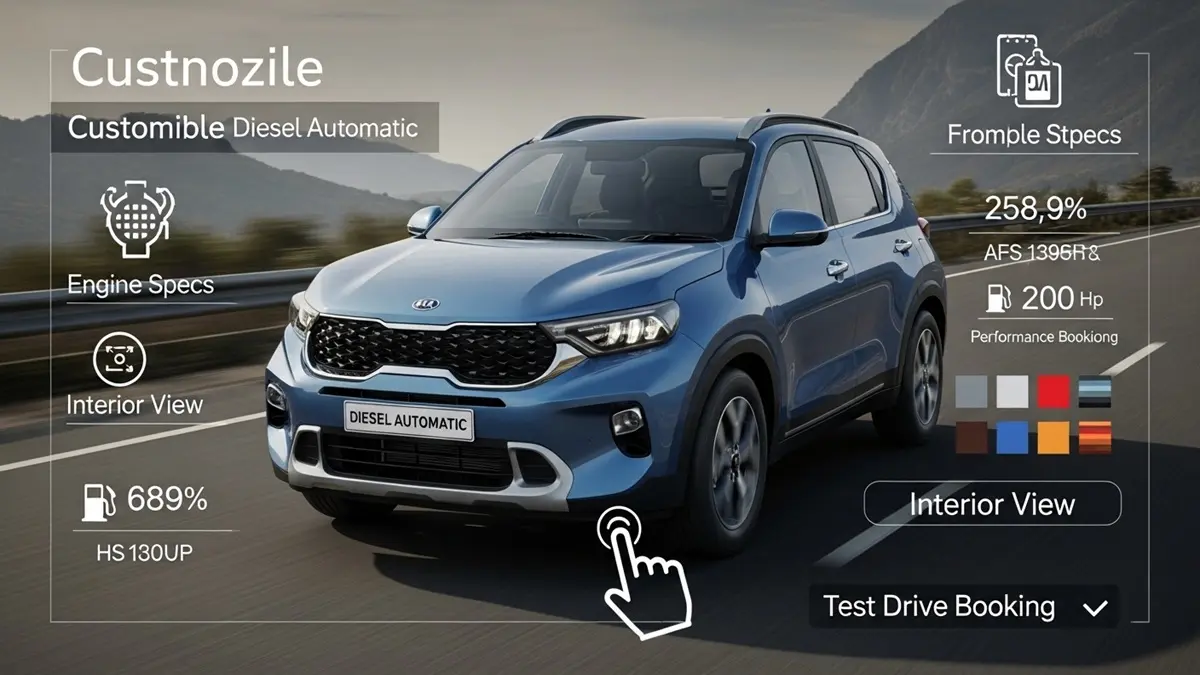
The sub-4m SUV segment in India is brutally competitive. Every manufacturer wants a piece of this pie, and the Kia Sonet has been a strong contender since its 2020 launch. For 2026, Kia has done something genuinely smart – they’ve made automatic transmissions accessible to budget-conscious buyers. The diesel automatic now starts under Rs 10 lakh. That’s a big deal.
I spent a week driving the updated Sonet through city traffic, open highways, and some pretty broken rural roads. Here’s the honest, no-nonsense breakdown of what works, what doesn’t, and who should buy it.
Design: Sharp, Sporty, and Still Fresh
The Sonet has always been a good-looking SUV. The 2026 model carries forward the same design language, and honestly, it hasn’t aged. At the front, you get those signature inverted L-shaped LED DRLs that give it an aggressive, almost tiger-like stance. The grille is chunky, and the overall proportions feel muscular.
The side profile is clean, with sharp creases that catch light nicely. Even the base variants get stylized steel wheels that cleverly look like alloys from a distance. At the rear, the LED taillights wrap around nicely, though lower variants miss out on the connecting light bar.
Kia has introduced a new colour for 2026 – Magma Red. It looks hot, especially with the black roof option on higher trims. Ground clearance is a healthy 205mm, which means you won’t be grinding your underbody on those unavoidable Indian speed breakers. The Sonet is 3,995 mm long, which is compact enough for city parking but still gives you that SUV presence.
One small gripe: the base variant doesn’t get roof rails, and the ORVMs are body-coloured but not foldable electronically. Minor stuff, but worth noting if you’re looking at the entry-level model.
Performance: Three Engines, Three Personalities
This is where the Sonet shines. Three engine options, each with a distinct character.
1.2-litre Naturally Aspirated Petrol (83 bhp / 115 Nm)
This is the mileage king. It’s a 4-cylinder engine, so it’s smooth and refined. No vibrations like some 3-cylinder rivals. Power delivery is linear, but don’t expect fireworks. Overtaking on highways needs planning. This one comes only with a 5-speed manual gearbox. Perfect for someone who drives sedately and prioritizes fuel economy over performance.
1.0-litre Turbo-Petrol (118 bhp / 172 Nm)
Now we’re talking. This 3-cylinder turbo engine is punchy. The torque kicks in early (from 1,500 rpm), which means you get that shove in the back without waiting for the revs to climb. The 7-speed DCT automatic is smooth for the most part, though in heavy stop-and-go traffic, it can feel slightly jerky – that’s the nature of dual-clutch gearboxes.
The turbo-petrol is the one to get if you enjoy driving. It’s responsive, and the engine note is sporty. But keep in mind, the claimed mileage is lower – around 18-19 km/l for the manual and 18.6 km/l for the DCT.

1.5-litre Diesel (114 bhp / 250 Nm)
This is the engine that made the Sonet famous. The torque – 250 Nm – is massive for this segment. And the best part? It now comes with a 6-speed torque converter automatic starting at just Rs 9.78 lakh.
I drove this combination through Bangalore traffic, and the torque converter gearbox is buttery smooth. No jerks, no hesitation. It just glides. On the highway, the diesel engine pulls strongly even at triple-digit speeds. The claimed mileage is 18.6 km/l for the diesel automatic and 22.3 km/l for the manual.
This is the most affordable diesel automatic sub-4m SUV in India right now. That’s not a small achievement.
Mileage & Real-World Range: What You’ll Actually Get
Let’s talk numbers that matter. ARAI figures are always optimistic. Here’s what owners and real-world tests suggest:
- 1.2L Petrol Manual: ARAI 18.4 km/l, real-world city 13-15 km/l, highway 17-19 km/l
- 1.0L Turbo DCT: ARAI 18.6 km/l, real-world city 12-14 km/l, highway 16-18 km/l
- 1.5L Diesel Manual: ARAI 22.3 km/l, real-world city 16-18 km/l, highway 21-23 km/l
- 1.5L Diesel Automatic: ARAI 18.6 km/l, real-world city 15-17 km/l, highway 18-20 km/l
The diesel, even with the automatic, is the most efficient in real-world conditions. The fuel tank holds 45 litres, which gives you a highway range of over 800 km on the diesel manual.
A few things that affect mileage – heavy AC usage, aggressive driving, and tyre pressure. Keep them in check, and the Sonet won’t hurt your wallet.
Safety: 6 Airbags Standard Across All Variants
This is a big one. The Kia Sonet comes with 6 airbags as standard across all variants – dual front, side, and curtain airbags. That’s not something every competitor can say.
Other standard safety features include Electronic Stability Control (ESC), Vehicle Stability Management (VSM), Hill Assist Control, ABS with EBD, rear parking sensors, and ISOFIX child seat mounts.
The Sonet has been tested by Bharat NCAP and received a 4-star safety rating for adult occupant protection. That’s solid for a sub-4m SUV.

Higher variants add Level 1 ADAS (Advanced Driver Assistance Systems) with 10 functions, including forward collision warning, lane departure warning, and high beam assist. There’s also a 360-degree camera on top trims, which makes parking in tight spots much easier.
One thing to note – the base HTE variant misses out on a reverse parking camera but gets two parking sensors. It’s workable, but you’ll want to be careful in tight spaces.
Interior & Features: Loaded, Even on Lower Trims
Step inside the Sonet, and you’ll notice the cabin feels premium for the price. The dashboard design is driver-focused, with all controls within easy reach. Even the base variants get a mix of fabric and leatherette upholstery, which feels better than plain cloth.
One surprise on lower trims – you get rear AC vents and two USB Type-C ports for rear passengers. That’s a thoughtful touch that many competitors miss on base models. There are also in-built sunshades in the rear doors, something usually reserved for more expensive cars.
Higher variants (from HTK+ onwards) get an 8-inch touchscreen with wireless Android Auto and Apple CarPlay, a 4.2-inch digital instrument cluster, cruise control, and a rear camera. The top-spec variants get a massive 10.25-inch touchscreen, a 10.25-inch digital driver’s display, ventilated front seats, a powered driver seat, a Bose sound system, and a sunroof.
The rear seat is comfortable for two adults. Three will be a squeeze – it’s a sub-4m SUV, after all. The boot space is 392 litres, which is among the largest in the segment. Weekend trips with family luggage? No problem.
Price Structure (Ex-showroom, Delhi)
The 2026 Kia Sonet is available in a wide range of variants. Here’s the breakdown:
- HTE (1.2L Petrol Manual): Rs 7.30 lakh
- HTE (O) (1.2L Petrol Manual): Rs 7.70 lakh
- HTK (1.2L Petrol Manual): Rs 8.41 lakh
- HTK (O) (1.2L Petrol Manual): Rs 8.74 lakh
- HTE (O) (1.5L Diesel Manual): Rs 8.98 lakh
- HTE (O) (1.5L Diesel Automatic): Rs 9.78 lakh (New)
- HTK (O) (1.0L Turbo DCT): Rs 9.89 lakh (New)
- HTK+ (1.5L Diesel Automatic): Rs 10.79 lakh
- HTX (1.0L Turbo DCT): Rs 12.10 lakh
- GTX+ (1.5L Diesel Automatic): Rs 14.09 lakh
On-road prices add about Rs 80,000-1,20,000 depending on your city’s RTO and insurance costs. The new diesel automatic HTE(O) variant will cost you around Rs 11.0-11.3 lakh on-road in most cities.
✅ Pros
- Diesel automatic now available under Rs 10 lakh – segment-first
- 6 airbags standard across all variants
- 3 engine options with distinct characters
- Smooth torque converter automatic on diesel
- Premium interior quality with rear AC vents even on base
- 392-litre boot – among the largest in segment
- 205mm ground clearance handles Indian roads well
- Level 1 ADAS available on higher trims
❌ Cons
- Rear seat is tight for three adults
- Base variant misses touchscreen and reverse camera
- DCT automatic can feel jerky in heavy traffic
- 1.2L petrol engine feels underpowered for highway overtakes
- No diesel manual in lower variants anymore
- Some rivals offer better safety ratings (5-star vs Sonet’s 4-star)

Comparison Table: Kia Sonet vs Top Rivals
The Sonet competes with the Hyundai Venue, Tata Nexon, and Maruti Suzuki Brezza – the giants of the sub-4m SUV segment. Here’s how they compare:
| Feature | Kia Sonet | Hyundai Venue | Tata Nexon | Maruti Brezza |
|---|---|---|---|---|
| Price (ex-showroom) | ₹7.30 – ₹14.09 lakh | ₹7.90 – ₹15.69 lakh | ₹8.00 – ₹15.80 lakh (approx) | ₹8.26 – ₹13.01 lakh |
| Engine Options | 1.2L Petrol, 1.0L Turbo, 1.5L Diesel | 1.2L Petrol, 1.0L Turbo, 1.5L Diesel | 1.2L Petrol, 1.2L Turbo, 1.5L Diesel | 1.5L Petrol, 1.5L CNG |
| Power (Top Engine) | 118 bhp | 118 bhp | 118 bhp (turbo) | 103 bhp |
| Mileage (Diesel/High) | 22.3 km/l (manual) | 21 km/l | 22.5 km/l (approx) | 25.51 km/l (diesel – but discontinued?) |
| Safety Rating | 4-star Bharat NCAP | 3-star Global NCAP | 5-star Global NCAP | 4-star Global NCAP |
| Airbags Standard | 6 | 6 | 6 | 2 (base), 6 (higher) |
| Boot Space | 392 litres | 350 litres | 382 litres | 328 litres |
| Ground Clearance | 205 mm | 209 mm | 198 mm | |
| Best For | Diesel automatic + feature-loaded cabin | Brand trust + smooth turbo engine | Mileage + Maruti’s service network |
Which one should you pick? Here’s the honest answer. If you want a diesel automatic and don’t want to break the bank, the Sonet is your only real choice in this price range. The torque converter gearbox is smooth, and the engine is punchy.
If safety is your absolute priority, the Tata Nexon with its 5-star Global NCAP rating is the smarter pick. You’ll compromise a bit on features at the same price point, but that safety rating gives genuine peace of mind.
If you want the smoothest turbo-petrol engine, the Hyundai Venue shares the same powertrain as the Sonet but has a slightly more premium feel and wider service network.
If mileage and low running costs are all that matter, the Maruti Brezza with its 1.5L petrol engine (and CNG option) is hard to beat. But it lacks a diesel option now.
For most buyers who drive in the city and take occasional highway trips, the Sonet diesel automatic offers the best balance of performance, efficiency, and convenience. That torque converter gearbox in traffic is a lifesaver, and the 4-star safety rating is respectable.
Frequently Asked Questions
A: The Kia Sonet is available in both petrol and diesel options. Petrol engines: 1.2L naturally aspirated and 1.0L turbo. Diesel engine: 1.5L. No electric or hybrid version yet.
A: The 2026 Kia Sonet diesel automatic (HTE O variant) starts at Rs 9.78 lakh (ex-showroom). This makes it the most affordable diesel automatic sub-4m SUV in India.
A: Expect 15-17 km/l in city traffic and 18-20 km/l on highways. The claimed ARAI mileage is 18.6 km/l.

A: Yes, the 2026 Kia Sonet comes with 6 airbags as standard across all variants – dual front, side, and curtain airbags.
A: The Kia Sonet has a 4-star Bharat NCAP safety rating for adult occupant protection. It’s a solid score for a sub-4m SUV, though the Tata Nexon has a 5-star rating.
A: The Kia Sonet has a ground clearance of 205 mm, which is good for Indian road conditions. You won’t have to worry about most speed breakers.
A: Yes, the Kia Sonet offers an electric sunroof on higher variants (from HTK+ onwards). The base variants do not get a sunroof.
A: Both share the same engines and platform. The Sonet has a more aggressive design and slightly better feature load for the price. The Venue has a wider service network and potentially better resale value. Drive both and see which one you prefer.
A: The Kia Sonet offers 392 litres of boot space, which is among the largest in the sub-4m SUV segment. It’s enough for four suitcases for a weekend trip.
A: Yes, especially the diesel variants. The torque converter automatic is smooth, the seats are comfortable, and the 45-litre fuel tank gives you over 800 km of highway range on the diesel manual. The turbo-petrol is also fun, but the mileage drops at high speeds.