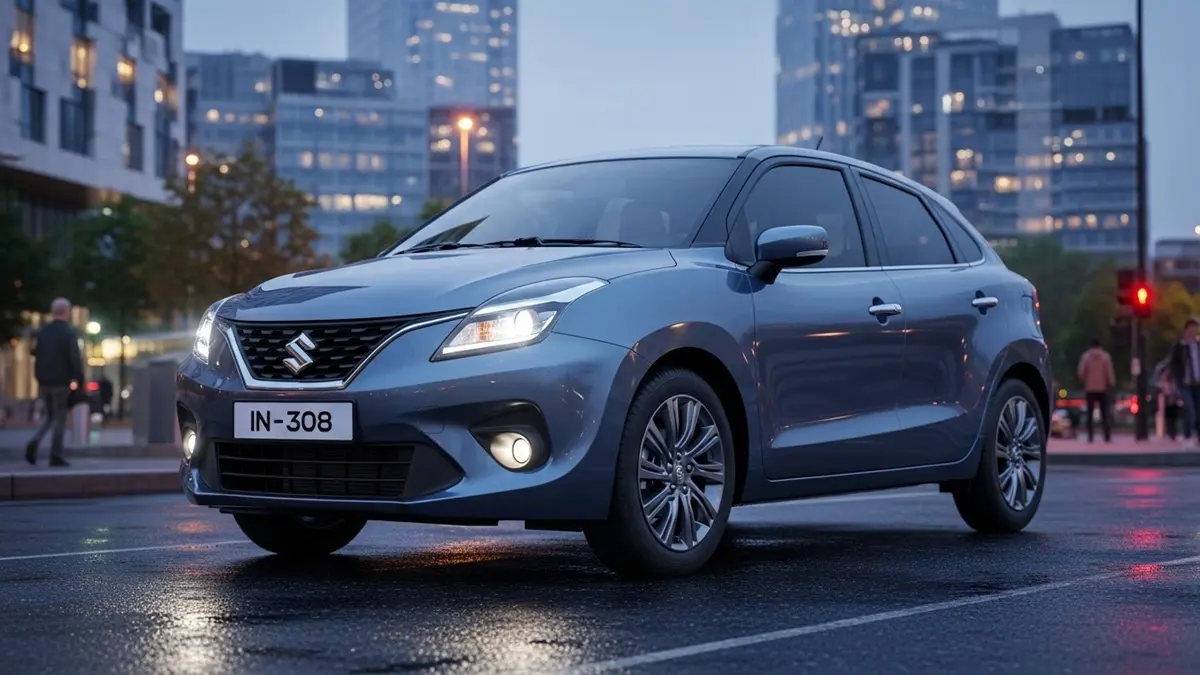
Maruti Baleno has been a consistent best-seller in India’s premium hatchback segment for years. And the 2026 model? It’s smarter, safer, and more practical than ever. I’ve driven this car through heavy Bangalore traffic, on smooth Mumbai expressways, and even on some not-so-smooth rural roads. Here’s what you need to know before you book one.
Design: Subtle Updates, Same Smart Looks
The Baleno has always been a good-looking car. For 2026, Maruti has made small tweaks rather than a full overhaul. The front grille gets bolder chrome accents, and the LED projector headlamps with signature DRLs give it that premium Nexa feel . The rear gets sharper LED taillamps, and the top variants ride on 16-inch alloy wheels that add a bit of stance.
What I appreciate is the size. At 3,990 mm long and 1,745 mm wide, it’s compact enough for city parking but spacious enough for five adults . The ground clearance is 170 mm, which is decent for Indian roads. You won’t scrape every speed breaker, but you’ll still want to slow down on the really nasty ones.
The dual-tone colour options look sharp. The Nexa Blue with a black roof? That turns heads. But here’s a small gripe – base variants still get steel wheels with covers. In 2026, that feels a bit cheap.
Performance: Smooth, Refined, and Easy to Drive
Under the hood sits Maruti’s trusted 1.2-litre, 4-cylinder K-series petrol engine. It produces 90 PS of power at 6,000 rpm and 113 Nm of torque at 4,400 rpm . Now, these numbers won’t make you a race car driver. But that’s not what the Baleno is about.
What you get is smooth, effortless driving. The engine is refined – no vibrations like some 3-cylinder rivals. Power delivery is linear, which means no sudden surges. Overtaking on highways requires a bit of planning, but it’s never stressful.
You have two gearbox options. The 5-speed manual is slick and easy to use – classic Maruti. The AMT (Automated Manual Transmission) is convenient for city driving, though it can feel a bit hesitant during quick overtakes. If you drive mostly in traffic, the AMT will save your left leg. If you enjoy driving, stick to the manual .
The CNG variant uses the same engine but with a factory-fitted kit. Power drops to about 77 bhp, but the running cost becomes incredibly low. Perfect for taxi operators or anyone who drives over 80 km daily .
Mileage & Real-World Range: The Real Hero
Let’s be honest – most people buy a Baleno for its fuel efficiency. And it delivers. The ARAI-certified mileage is 22.35 km/l for the petrol manual and 22.94 km/l for the AMT . But those are test conditions. In the real world, here’s what you can expect :

- City driving (with AC): 13-17 km/l for manual, 14-18 km/l for AMT
- Highway driving (steady 80-90 km/h): 22-24 km/l
- CNG city: 21-25 km/kg
- CNG highway: 26-28 km/kg
The fuel tank holds 37 litres . A full tank costs around ₹3,700 (at ₹100/litre) and gives you a real-world range of 500-700 km depending on driving conditions . The CNG variant can stretch that to over 900 km on a full tank and full cylinder. That’s genuinely impressive.
A few things affect mileage. Heavy AC usage drops efficiency by 1-2 km/l. Aggressive driving with sudden acceleration and braking also hurts. And under-inflated tyres? That can cost you another 1-2 km/l . Keep these in check, and the Baleno will treat your wallet well.
Service costs are low. Several owners report average service costs of around ₹5,000-7,000 per visit . Maruti’s service network is everywhere, and parts are cheap. This matters for long-term ownership.
Safety: Finally, Six Airbags Standard
This is the biggest news for 2026. Maruti has made six airbags standard across all Baleno variants . That means dual front, side, and curtain airbags even on the base Sigma model. This is a massive step forward for a Maruti hatchback.
The Baleno also earned a 4-star Bharat NCAP safety rating in 2025, which carries over to the 2026 model . That’s the first 4-star rating for a Maruti hatchback. You also get ABS with EBD, brake assist, rear parking sensors, and ISOFIX child seat mounts as standard.
Higher variants add Electronic Stability Program (ESP), hill hold assist (for AMT variants), and a 360-degree camera . The reverse camera quality is decent – not class-leading but perfectly usable.
Now, here’s the honest truth. The Baleno’s body structure isn’t as rigid as a Tata Altroz. Maruti still prioritises lightweight construction for mileage. But the six airbags make a real difference in crash protection. For city driving at moderate speeds, the Baleno is safe enough. If you do a lot of highway driving and safety is your absolute top priority, the Altroz with its 5-star rating might be a better fit.
The 360-degree camera on top variants is genuinely useful for tight parking spots. And the rear parking sensors work well – they beep early enough to give you warning.

Interior & Features: Spacious and Well-Equipped
Step inside the Baleno, and the first thing you notice is the space. The flat floor in the back means three adults can sit without fighting for foot room. Rear legroom is generous – even with a tall driver up front, passengers won’t complain.
The 318-litre boot is among the largest in the segment . Weekend trips with luggage for a family of four? No problem. The rear seats fold in a 60:40 split for extra space when needed.
On the features front, the top Zeta and Alpha trims get a 9-inch floating touchscreen with wireless Android Auto and Apple CarPlay . The Arkamys-tuned sound system has six speakers and sounds pretty good for this class. Not audiophile level, but perfectly fine for daily listening.
Other niceties include automatic climate control, rear AC vents (a blessing in Indian summers), keyless entry, push-button start, and a cooled glovebox. The steering wheel gets mounted controls for audio and calls. The digital instrument cluster on higher variants looks modern and shows all the information you need .
What’s missing? A sunroof. The Baleno doesn’t offer one even on the top variant. If that’s a deal-breaker for you, look at the Hyundai i20 or Tata Altroz. Also, the base Sigma variant is very barebones – no touchscreen, no alloy wheels, basic interior. Spend a bit more for the Delta or Zeta if your budget allows.
Price Structure (Ex-showroom, Delhi)
The Baleno is available in multiple variants. Here’s the breakdown :
- Sigma (Petrol Manual): ₹6.66 lakh
- Delta (Petrol Manual): ₹7.50 lakh (approx)
- Delta AMT (Petrol Automatic): ₹8.00 lakh (approx)
- Zeta (Petrol Manual): ₹8.55 lakh (approx)
- Zeta AMT: ₹9.05 lakh (approx)
- Alpha (Petrol Manual): ₹9.30 lakh (approx)
- Alpha AMT: ₹9.83 lakh
- CNG variants (Delta, Zeta): ₹8.00 lakh to ₹9.15 lakh
On-road prices add about ₹70,000-1,00,000 depending on your city’s RTO and insurance costs . The Alpha AMT in Mumbai or Delhi will cost you around ₹10.80-11.20 lakh on-road.
✅ Pros
- Excellent fuel efficiency – saves you real money every month
- Six airbags now standard across all variants
- Spacious cabin with great rear legroom and boot space
- 4-star Bharat NCAP safety rating – first for a Maruti hatchback
- Huge service network, low maintenance costs
- Smooth, refined 4-cylinder engine (no vibrations)
- Strong resale value – you won’t lose much when selling
❌ Cons
- No sunroof, even on top variants
- AMT gearbox feels hesitant during quick overtakes
- Base variants miss out on alloy wheels and touchscreen
- Body structure not as rigid as Tata Altroz
- Rear drum brakes feel dated in this segment
- No diesel or strong hybrid option

Comparison Table: Baleno vs Top Rivals
The Baleno competes directly with the Toyota Glanza (its mechanical twin), Hyundai i20, and Tata Altroz. Here’s how they stack up :
| Feature | Maruti Baleno | Toyota Glanza | Hyundai i20 | Tata Altroz |
|---|---|---|---|---|
| Price (ex-showroom) | ₹6.66 – ₹9.83 lakh | ₹6.86 – ₹10.00 lakh | ₹7.04 – ₹11.21 lakh | ₹6.65 – ₹10.80 lakh |
| Engine | 1.2L 4-cyl petrol, 90 bhp | 1.2L 4-cyl petrol, 90 bhp | 1.2L 4-cyl / 1.0L turbo, 83-120 bhp | 1.2L petrol / 1.5L diesel, 90-110 bhp |
| Mileage (ARAI) | 22.94 km/l | 22.35 km/l | 20 km/l approx | 19-23 km/l |
| Real-world city mileage | 16-18 km/l | 16-18 km/l | 13-16 km/l | 14-17 km/l |
| Safety rating | 4-star Bharat NCAP | Untested (similar to Baleno) | 3-star Global NCAP | 5-star Global NCAP |
| Airbags | 6 standard | 6 standard | 6 standard (select variants) | 6 standard (select variants) |
| Boot space | 318 litres | 318 litres | 311 litres | 345 litres |
| Sunroof | No | No | Yes (electric) | Yes (electric) |
| Service network | Excellent | Very Good | Excellent | Good |
| Best for | Fuel efficiency + low running costs + resale value | Similar to Baleno, with Toyota badge | Premium features + turbo performance | Safety + build quality + diesel option |
Which one should you pick? Here’s my honest advice. If fuel efficiency, low maintenance, and resale value are your top priorities, the Baleno is the clear winner. The Glanza is essentially the same car with a Toyota badge and slightly different styling – pick whichever dealer offers you a better deal.
If you want a sunroof, a turbo petrol engine, and a more premium interior, spend the extra money on the Hyundai i20. It feels more upmarket but costs more to run.
If safety is your absolute non-negotiable priority – especially if you do a lot of highway driving with family – the Tata Altroz with its 5-star rating is the smart choice. You’ll compromise a bit on mileage and the engine isn’t as refined, but that safety rating gives genuine peace of mind .
For most Indian buyers driving primarily in cities, the Baleno strikes the best balance of running costs, space, and now improved safety.
Frequently Asked Questions
A: The 2026 Maruti Baleno is a petrol and CNG car only. Maruti has discontinued diesel engines across all its hatchbacks. The Baleno runs on a 1.2-litre, 4-cylinder K-series petrol engine .
A: Expect 16-18 km/l in city driving with AC on for the manual variant. The AMT gives slightly better mileage – around 17-19 km/l. On highways, you can get 22-24 km/l . CNG variants deliver 21-25 km/kg in the city.
A: Yes, the 2026 Maruti Baleno comes with six airbags as standard across all variants – dual front, side, and curtain airbags. This is a significant safety upgrade for 2026 .

A: The Baleno has a 4-star Bharat NCAP safety rating from 2025, which continues for the 2026 model. This is the first Maruti hatchback to achieve this rating .
A: The base Sigma variant costs around ₹7.36-7.50 lakh on-road in Delhi. The top-end Alpha AMT will set you back about ₹10.80-11.20 lakh on-road, depending on insurance and RTO charges .
A: No, the Maruti Baleno does not offer a sunroof in any variant. If you want a sunroof in this price range, look at the Hyundai i20 or Tata Altroz .
A: The Zeta AMT is the sweet spot. It gives you the 9-inch touchscreen, automatic climate control, rear AC vents, keyless entry, and six airbags – all for around ₹9.05 lakh ex-showroom. The Delta is a good budget choice if you can live without the larger screen .
A: The Toyota Glanza is essentially a rebadged Baleno. Both cars share the same engine, platform, and features. The differences are minor – front grille design, badge, and dealer network. Choose whichever offers a better price or is more convenient for service .