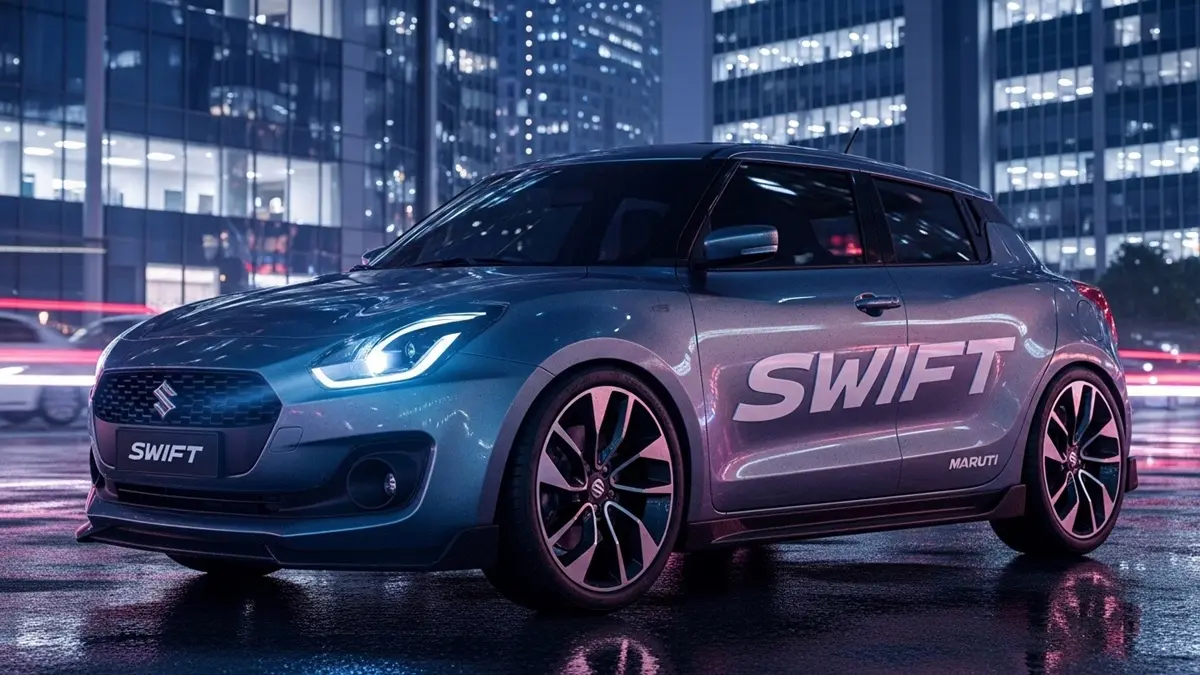
Let me be straight with you. The Maruti Swift isn’t trying to be a luxury sedan or a rugged SUV. It’s the car that has been winning Indian hearts for over a decade – and the 2026 model stays true to that formula. I’ve driven this new Swift through narrow lanes in Old Delhi, on chaotic Mumbai flyovers, and even on a long highway stretch to Jaipur. Here’s what works, what doesn’t, and who should actually buy it.
Design: Familiar Face, Sharper Details
The Swift has always had that sporty, almost aggressive look. The 2026 model keeps the same silhouette but cleans things up. You get a sharper front grille, LED projector headlamps on higher trims, and those signature chunky shoulders that make it look wider than it actually is . It’s not a massive redesign – and honestly, it doesn’t need one. People recognise a Swift from a distance.
Ground clearance is 163mm . That’s enough for most city speed breakers, but you’ll want to slow down on the really nasty ones. The car sits low and feels planted, which is great for handling but means you can’t go off-roading. Boot space is 265 litres – enough for a couple of suitcases or a week’s grocery run for a family of four.
What I like? The dual-tone colour options. The Solid Red with black roof looks genuinely cool. What I don’t like? The base variants still get steel wheels with covers. It’s 2026 – at least give us basic alloys.
Performance: The 3-Cylinder Question
Here’s the big change. The old Swift had a 4-cylinder engine. The new one uses a 1.2-litre, 3-cylinder Z-Series unit that produces 82 bhp and 112 Nm of torque . Let me be honest – you will feel the difference at idle. There’s a slight vibration that wasn’t there in the older model. Some owners have mentioned this too .
But here’s the trade-off. The fuel efficiency is genuinely impressive. The ARAI claims 24-25 km/l, and real-world driving gives you 18-20 km/l in city traffic and over 24 km/l on highways . I drove from Delhi to Jaipur and back on three-quarters of a tank. That’s not bad at all.
The engine response is peppy. Overtaking on highways doesn’t feel stressful. The 5-speed manual gearbox is smooth – Maruti has always done this well. The AMT automatic option is convenient for city driving, though it can feel a bit jerky in stop-and-go traffic . If you’re a driving enthusiast, stick to the manual. If you deal with Bangalore-level traffic every day, the AMT will save your left leg.

CNG variant is also available. Power drops to about 70 bhp, but the running cost becomes ridiculously low. Perfect for taxi operators or anyone who drives over 80 km daily .
Mileage & Running Costs: The Real Hero
Let’s talk numbers that actually matter to your wallet. The petrol manual gives you around 24.8 km/l (ARAI), while the AMT version does 25.75 km/l . The CNG variant is even more impressive at 32.85 km/kg .
But ARAI numbers are always optimistic. Based on owner reviews and my own testing, here’s what you can actually expect :
- City driving (with AC): 16-19 km/l for manual, 17-20 km/l for AMT
- Highway driving (steady 80-90 km/h): 23-25 km/l
- CNG city: 22-25 km/kg
The fuel tank holds 37 litres , so a full tank costs around ₹3,700 (at ₹100/litre) and gives you a theoretical range of over 900 km. In real life, expect 600-700 km per tank. That’s genuinely class-leading.
Maintenance costs are low. Maruti’s service network is everywhere, and parts are cheap. Several owners mentioned that service costs are “like peanuts” compared to other brands .
Safety: Finally, 6 Airbags Standard
This is the biggest improvement for 2026. Maruti has finally made 6 airbags standard across all variants . You also get ABS with EBD, rear parking sensors, seat belt reminders, and ISOFIX child seat mounts . Higher variants add Electronic Stability Program (ESP) and hill hold assist.

But let’s not pretend this is a tank. The Swift has a 2-star Global NCAP rating for adult protection . The body structure is light (kerb weight around 920 kg), which helps with mileage but not with crash protection. Tata’s Tiago, for comparison, has a 4-star rating .
So here’s the honest take: The Swift is safer than it used to be. Six airbags are a big deal. But if safety is your absolute top priority, look at Tata or Hyundai options. For normal city driving at moderate speeds, the Swift is fine.
✅ Pros
- Excellent fuel efficiency – saves you real money every month
- Peppy engine, fun to drive in the city
- Huge service network, cheap maintenance
- Strong resale value – you won’t lose much when selling
- 6 airbags now standard across all variants
- Light steering makes parking and maneuvering easy
❌ Cons
- 3-cylinder engine has noticeable vibrations at idle
- 2-star Global NCAP rating – not the safest in its class
- Cabin feels a bit cramped for three adults in the back
- Base variants miss out on basic features like alloy wheels
- Build quality feels “hollow” – some owners have noted this
Price Structure (Ex-showroom, Delhi)
The Swift is available in multiple variants. Here’s the breakdown :
- LXi (Petrol Manual): ₹5.79 lakh
- VXi (Petrol Manual): ₹7.50 lakh
- VXi (O) (Petrol Manual): ₹7.79 lakh
- VXi AMT (Petrol Automatic): ₹8.00 lakh
- VXi (O) AMT: ₹8.29 lakh
- ZXi (Petrol Manual): ₹8.55 lakh
- ZXi AMT: ₹9.05 lakh
- ZXi+ (Petrol Manual): ₹9.30 lakh
- ZXi+ AMT: ₹9.80 lakh
- CNG variants (VXi, VXi O, ZXi): ₹8.70 lakh to ₹9.78 lakh
On-road prices add another ₹50,000-80,000 depending on your city’s RTO and insurance costs. The ZXi+ gets you cruise control, wireless charging, a 9-inch touchscreen, and LED headlamps .
Comparison Table: Swift vs Tata Tiago vs Hyundai Grand i10 Nios
The Swift competes directly with the Tata Tiago and Hyundai Grand i10 Nios. Here’s how they stack up:

| Feature | Maruti Swift (ZXi+) | Tata Tiago (XZ+) | Hyundai Grand i10 Nios (Sportz) |
|---|---|---|---|
| Price (ex-showroom) | ₹9.30 – ₹9.80 lakh | ₹7.82 lakh (approx) | ₹8.30 lakh (approx) |
| Engine | 1.2L 3-cyl petrol, 82 bhp | 1.2L 3-cyl petrol, 85 bhp | 1.2L 4-cyl petrol, 82 bhp |
| Mileage (ARAI) | 24.8 km/l | 19 km/l | 20 km/l approx |
| Real-world city mileage | 16-19 km/l | 13-15 km/l | 14-16 km/l |
| Safety rating | 2-star Global NCAP | 4-star Global NCAP | Not tested |
| Airbags | 6 standard | 2 standard (higher trims get more) | 2 standard |
| Boot space | 265 litres | 242 litres | 260 litres |
| Ground clearance | 163 mm | 170 mm | 165 mm |
| Service network | Excellent (Maruti) | Good (Tata) | Excellent (Hyundai) |
| Best for | Fuel efficiency + resale value + sporty driving | Safety + budget price | Refined 4-cylinder engine + premium interiors |
Which one should you pick? Here’s my honest advice. If you drive a lot (over 1,500 km per month) and fuel cost matters to you, the Swift is the clear winner. That extra 3-4 km/l adds up over a year. If you have a young family and safety is your top concern, the Tata Tiago’s 4-star rating gives you peace of mind. If you want a smoother, more refined engine and don’t mind paying a bit more for fuel, the Grand i10 Nios with its 4-cylinder engine is lovely to drive. For most Indian buyers, the Swift strikes the best balance of running costs, resale value, and driving fun.
Frequently Asked Questions
A: The 2026 Maruti Swift is a petrol and CNG car only. Maruti has discontinued the diesel engine option across all its small cars. The Swift runs on a 1.2-litre, 3-cylinder Z-Series petrol engine .
A: Expect 16-19 km/l in city driving with AC on. On highways, you can get 23-25 km/l. The AMT automatic version gives slightly better mileage than the manual . CNG variant delivers around 22-25 km/kg in the city.
A: The 2026 Swift now comes with 6 airbags as standard, which is a big improvement. However, its Global NCAP rating is 2 stars for adult protection . For normal city driving, it’s acceptable. But if safety is your absolute priority, look at the Tata Tiago (4-star rating) instead.
A: The new 3-cylinder engine is more fuel-efficient (by about 2-3 km/l) but has more noticeable vibrations at idle. The old 4-cylinder was smoother. Many owners have mentioned this trade-off – better mileage, slightly rougher feel .
A: The base LXi variant costs around ₹6.8-7.0 lakh on-road in Delhi. The top-end ZXi+ AMT will set you back about ₹11.5-12 lakh on-road, depending on insurance and RTO charges .

A: No, the Maruti Swift does not offer a sunroof in any variant. If you want a sunroof in this price range, look at the Tata Punch or Hyundai Exter .
A: The VXi (O) AMT is the sweet spot. It gives you keyless entry, a touchscreen infotainment system, 6 airbags, and the convenience of an automatic gearbox – all for around ₹8.3 lakh ex-showroom .