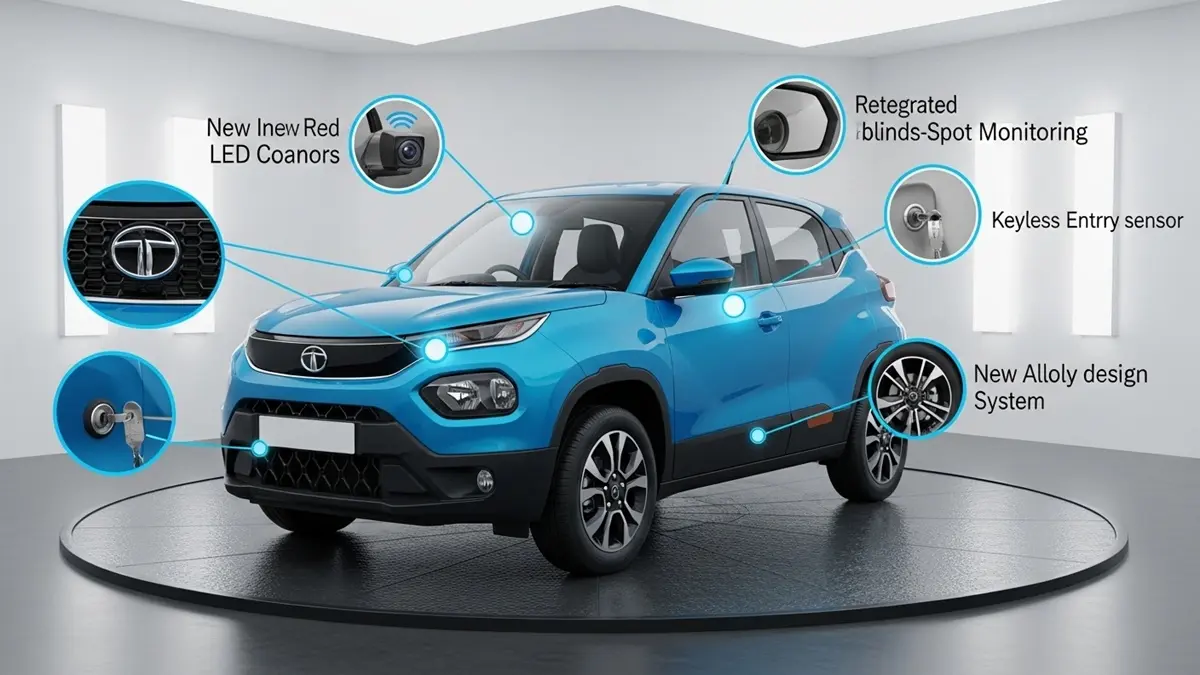
Arre bhai, let me be honest with you. When Tata launched the Punch back in 2021, everyone loved the 5-star safety and the chunky looks, but we all secretly whispered the same complaint – “bhai, power thodi kam hai.” Highway overtakes used to require a lot of planning. Now, fast forward to 2026, and Tata has dropped the Punch facelift with a proper turbo petrol engine and a massive feature list . I drove the new 1.2L Turbo (120 PS) manual and the CNG AMT version through the hills of Lonavala and the traffic of Pune. Does it finally deserve the hype? Let’s cut the cliches and talk desi facts.
Before we dive in, if you want ownership costs that don’t lie, always cross-verify your on-road price and maintenance schedule at https://www.claviscar.online/. We don’t do sugarcoating here, just honest, no-nonsense car advice.
Road Presence: The ‘Baby Harrier’ Look Works Wonders
Park the new Punch next to the old one, and the difference is clear. The front end now gets a full LED lighting setup and a redesigned grille that brings it in line with the modern Tata family face. It has become 49mm longer as a result, largely due to the tougher new bumpers . The rear now features a full-width connected LED light bar that looks surprisingly premium at night. The 193mm ground clearance (up by 6mm from before) is a blessing for our monsoon waterlogging and those random speed breakers that appear out of nowhere .
One thing I’m not a fan of – the grey plastic cladding on the sides. Tata says black cladding was prone to visible scratches, but this new grey finish looks a bit unfinished, almost primer-like . That said, the overall stance remains upright, confident, and very “mini SUV.”
Cabin Comfort: Tech-Loaded But Practical?
Step inside, and the first thing that hits you is the massive 10.25-inch touchscreen (thinner bezels now) and the new 7-inch digital driver’s display . The older LCD display was hard to read; this new one is much brighter and shows more information. The dashboard now gets a speckled white panel that looks quite premium, though you still won’t find soft-touch plastics everywhere – the door armrest could use more cushioning .

The new capacitive climate control panel looks smart but honestly, it’s a step backward in usability. You have to take your eyes off the road to adjust things. The older chunky buttons were much easier to use on the move .
Features? You get a 360-degree HD camera (a lifesaver in tight gullies), a single-pane sunroof, wireless charger, ventilated front seats, and even paddle shifters on the AMT . The rear AC vents work well – a must-have for Indian summers. The boot space remains 366 litres for the petrol, which is enough for a couple of strollers and bags for a weekend trip. The CNG version, with its twin-cylinder technology, offers 210 litres of usable space – enough for a large suitcase, and you still get a spare wheel .
Performance: The Turbo Is A Game Changer
Here is the heart of the matter. Tata now offers three engine options, and the difference is night and day :
- 1.2L Naturally Aspirated (88 PS / 115 Nm): This is the old workhorse. It is refined and peppy enough for city commutes, but on the highway, you need to downshift to overtake. The AMT on this is decent but has the usual rubber-band effect. Real-world mileage: 15-17 kmpl in mixed conditions.
- 1.2L Turbo Petrol (120 PS / 170 Nm): Bhai, yeh wali lo. Borrowed from the Nexon, this engine transforms the Punch. It pulls cleanly from as low as 1,750 rpm, and the 6-speed manual gearbox (with shorter throws than before) is much nicer to use. Overtaking on the highway no longer requires a prayer. Tata claims a 0-100 kmph in around 11 seconds . The only downside? No automatic option on the turbo yet.
- 1.2L CNG (73 PS / 103 Nm): The star for fleet operators and budget-conscious buyers. It now comes with a 5-speed AMT, making it one of the first factory-fitted automatic CNG SUVs in India . It’s not fast – overtakes need planning – but the running cost of under ₹4 per km makes it a money-printing machine.
The suspension has been reworked for the turbo version. It’s slightly firm at low speeds but handles bad roads with confidence. At highway speeds, it feels stable and planted – not like a small hatchback at all .

Safety: Still The Class Leader
The Tata Punch is the reason other manufacturers started caring about safety. It holds a 5-star Bharat NCAP rating for adult and child protection, and this rating applies to all variants and powertrains, including the CNG . The facelift continues this legacy with 6 airbags as standard across the entire lineup, along with ESP, Hill Hold Assist, and ISOFIX child seat mounts .
The addition of the 360-degree camera on higher trims is not a gimmick; it actually helps you see those hidden poles and kids playing around the car. The blind-spot monitor that activates when you indicate is also genuinely useful .
Structurally, this is still the safest car in the segment. Period. If safety is your number one priority, the Punch is the obvious choice.
Pros 👍
- ✅ 5-Star Safety: 6 airbags standard, proven bodyshell.
- ✅ Turbo Engine: Finally, the Punch has real highway muscle.
- ✅ 360-Degree Camera: Segment-first feature, genuinely useful.
- ✅ CNG + AMT: Perfect for taxi/fleet or budget buyers.
- ✅ Ride Quality: Absorbs our broken roads with confidence.
- ✅ Ground Clearance: 193mm means no more scraping.
Cons 👎
- ❌ No Turbo Auto: If you want turbo power with automatic convenience, wait.
- ❌ Small Boot (CNG): Only 210L with the CNG kit, less than rivals.
- ❌ Capacitive Controls: Climate panel is annoying to use while driving.
- ❌ Rear Seat Width: Three adults is still a tight squeeze.
- ❌ Grey Cladding: Looks cheap compared to the older black finish.

Frequently Asked Questions (FAQs)
Q1: What is the real-world mileage of the 2026 Tata Punch?
A: In mixed city/highway driving, the Petrol Manual gives around 16-18 kmpl (ARAI claims 20.09 kmpl). The Petrol AMT gives around 15-17 kmpl. The CNG Manual delivers an excellent 22-24 km/kg in real-world conditions .
Q2: Is the Tata Punch Turbo automatic available?
A: As of the launch in January 2026, the 1.2L Turbo is only available with a 6-speed manual gearbox. Tata might introduce a DCT or torque converter later, but currently, no automatic for the turbo .
Q3: Is the Tata Punch safer than the Hyundai Exter?
A: On paper, yes. The Punch has an official 5-star Bharat NCAP rating . The Exter has not been officially tested yet, though it now comes with 6 airbags standard. The Punch has a proven, stronger bodyshell .
Q4: Does the 2026 Punch CNG come with an automatic?
A: Yes! This is a big update. Tata now offers the Punch iCNG with a 5-speed AMT, making it one of the first factory-fitted automatic CNG cars in India .
Q5: What is the starting price of the 2026 Tata Punch?
A: The 2026 Tata Punch starts at ₹5.59 lakh (ex-showroom) for the base Smart petrol manual variant, going up to ₹10.54 lakh for the top-end CNG AMT variant .

2026 Tata Punch vs Hyundai Exter vs Maruti Ignis
Confused between the three micro-SUVs? Here is the honest spec sheet comparison based on latest 2026 data.
| Feature | Tata Punch (2026) | Hyundai Exter (2026) | Maruti Ignis |
|---|---|---|---|
| Ex-Showroom Price | ₹5.59 Lakh – ₹10.54 Lakh | ₹5.79 Lakh – ₹9.42 Lakh | ₹5.35 Lakh – ₹7.55 Lakh |
| Engine Options | 1.2L NA (88 PS) 1.2L Turbo (120 PS) 1.2L CNG (73 PS) |
1.2L NA (83 PS) 1.2L CNG (4-cyl) |
1.2L NA (82 PS) 4-Cylinder |
| Safety Rating | 5-Star (Bharat NCAP) | Not Tested (6 Airbags Std) | 1-Star (Global NCAP) |
| Key Features | 360° Camera, Sunroof, Ventilated Seats, 10.25″ Screen | Dashcam, Sunroof, 8″ Screen, 4-Cyl Engine | Light Steering, High Seating, 4-Cyl Engine |
| Boot Space | 366L (Petrol) / 210L (CNG) | 391L (Petrol) / 225L (CNG) | 260L |
| Best For | Safety & Highway Cruising (Best for families & enthusiasts) | Feature Lovers & Refinement (Best for 4-cyl smoothness & boot space) | Budget City Driving (Best for ease of parking & low maintenance) |
Final Verdict: If safety is your non-negotiable and you drive on highways, the Tata Punch Turbo is the obvious winner – the 5-star rating and 120 PS engine are unbeatable at this price. If you want maximum boot space and the smoothness of a 4-cylinder engine, the Hyundai Exter is a strong second choice. The Ignis feels outdated in 2026 with its 1-star safety rating, unless you’re on a tight budget and only drive in the city .