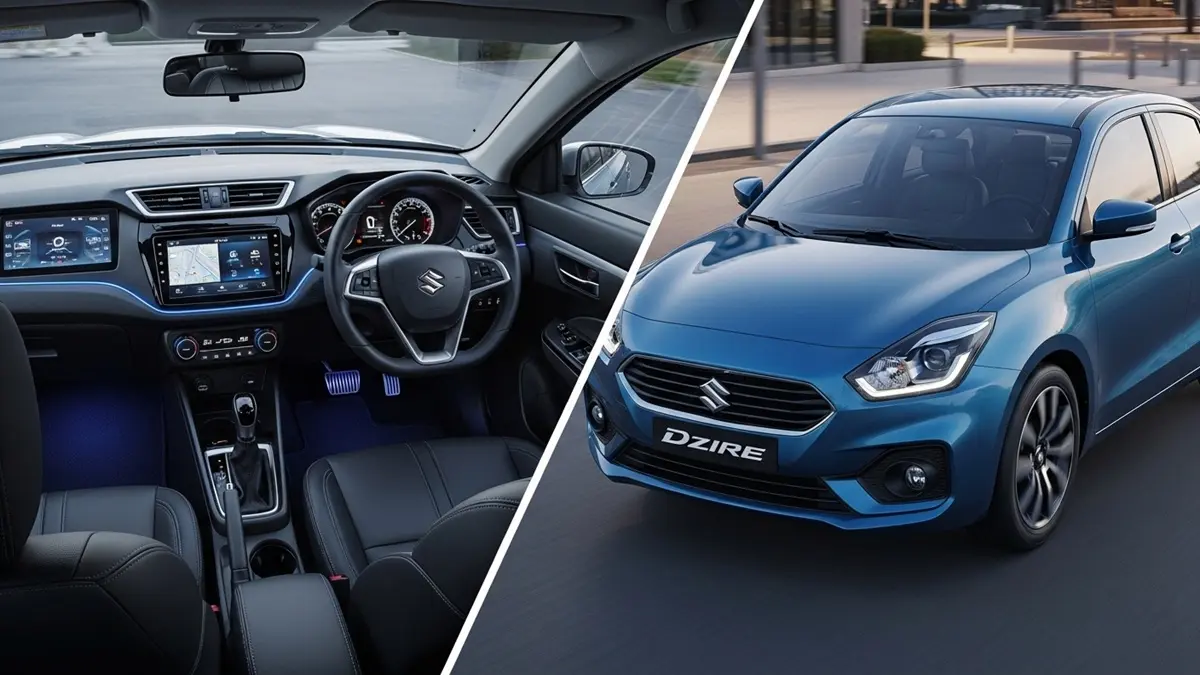
Maruti Dzire has been India’s best-selling sedan for years. In February 2026 alone, it sold 19,326 units — more than every other sedan combined . That’s not luck. That’s understanding exactly what Indian families want: fuel efficiency, low maintenance, and now, finally, top-notch safety.
The 2026 Dzire is the fourth-generation model, launched in late 2024 with updates continuing into 2026 . I’ve driven this car through city traffic, on highways, and on broken rural roads. Let me tell you what works, what doesn’t, and why it’s still the default choice for so many buyers.
Design: Compact Sedan Proportions Done Right
The Dzire is 3,995 mm long, 1,735 mm wide, and 1,525 mm tall . That sub-4 metre length keeps excise duties low, which keeps the price attractive. But unlike some compact sedans that look squished, the Dzire has proper sedan proportions. The boot isn’t an afterthought — it flows naturally from the cabin.
The 2026 model gets a refreshed front with sleek LED headlamps, a bolder grille, and connected LED tail lamps at the rear . Chrome accents on the grille and window line add a touch of elegance. Higher variants get 14-inch alloy wheels that fill the wheel arches nicely.
Ground clearance is 163 mm . That’s adequate for most Indian roads. You won’t scrape every speed breaker, but you’ll want to slow down for the really nasty ones. The 4.8 metre turning radius makes U-turns manageable in city traffic .
Seven colour options are available, including Splendid Silver, Gallant Red, and Arctic White . The dual-tone options on higher variants add some visual flair.
Performance: City-Friendly, Not a Highway Racer
Under the bonnet sits Maruti’s new 1.2-litre Z-series three-cylinder petrol engine. It produces 80 bhp at 5,700 rpm and 112 Nm of torque at 4,300 rpm . These numbers won’t win any drag races. But that’s not what the Dzire is about.
The engine is tuned for low-end torque, which means you don’t need to rev it hard in city traffic. The 5-speed manual gearbox is light and easy to use — classic Maruti. The AMT (Automated Manual Transmission) is available on higher variants. It’s not the smoothest automatic you’ll ever drive, but for stop-and-go traffic, it saves your left leg .
On the highway, the Dzire is comfortable up to 90-100 km/h. Push it beyond that, and the engine feels strained. Overtaking requires planning, especially when the car is fully loaded . If you’re the kind of driver who enjoys quick overtakes, this engine will feel a bit lazy.
The CNG variant produces about 69 bhp and 102 Nm of torque when running on gas . Power drops noticeably, especially on inclines. But if you drive a lot, the fuel savings make it worth the compromise.
One thing to note — the three-cylinder engine has some vibrations at idle. It’s not bothersome, but you’ll feel it if you’re coming from a four-cylinder car. Maruti has done a decent job of isolating vibrations, but they haven’t eliminated them completely.

Mileage & Real-World Range: The Dzire’s Superpower
This is why people buy the Dzire. The ARAI-certified figures are impressive :
- Petrol Manual: 24.79 km/l
- Petrol AMT: 25.71 km/l
- CNG Manual: 33.73 km/kg
But ARAI numbers are always optimistic. In the real world, here’s what owners report :
- Petrol Manual in city: 14-16 km/l
- Petrol Manual on highway: 19-21 km/l
- Petrol AMT in city: 13-15 km/l
- Petrol AMT on highway: 18-20 km/l
- CNG in city: 22-24 km/kg
- CNG on highway: 28-30 km/kg
The fuel tank holds 37 litres . On the petrol manual, a full tank gives you a city range of 500-550 km and a highway range of over 700 km. The CNG tank has a 55-litre water capacity, holding roughly 8-9 kg of gas, giving you around 220-250 km per fill .
Let me put the running costs in perspective. Using Delhi prices (petrol ~₹95/litre, CNG ~₹76/kg) :
- Petrol Manual: About ₹5.2 per kilometre
- CNG: About ₹2.1 per kilometre
If you drive 1,500 km a month, the CNG version saves you roughly ₹4,500-5,000 every single month. Over five years, that’s over ₹2.5 lakh in savings . That’s real money for a middle-class family.
A few things that affect mileage: heavy AC usage drops efficiency by 1-2 km/l . Aggressive driving with sudden acceleration also hurts. Under-inflated tyres can cost you another 1-2 km/l. Keep these in check, and the Dzire will treat your wallet well.
Interior & Features: Practical, Not Plush
Step inside the Dzire, and you won’t find any luxury. The dashboard is functional, with hard plastics everywhere. But the ergonomics are spot-on — buttons are where you expect them, and the driving position is comfortable.
The base LXI variant is very barebones — no touchscreen, steel wheels, basic audio system. The VXI is where the Dzire starts making sense. It gets a 7-inch touchscreen with Android Auto and Apple CarPlay, manual climate control, rear AC vents, and keyless entry .
The ZXI and ZXI+ variants add LED headlamps, cruise control, an electric sunroof, a 360-degree camera, a wireless charging pad, and Suzuki Connect connected car tech . The 360-degree camera is particularly useful for parking in tight spots — the Dzire’s rear visibility isn’t great.
Rear seat space is generous. The 2,450 mm wheelbase and flat floor mean three adults can sit without fighting for foot room . The rear AC vents are a blessing in Indian summers, and they’re available from the VXI variant onwards.

The boot space is 382 litres . That’s enough for four suitcases for a weekend trip. The CNG variant’s boot is significantly smaller because of the cylinder — around 142 litres. If luggage space is a priority, stick to petrol.
What’s missing? Ventilated seats, a panoramic sunroof (you get a standard electric sunroof), and any kind of premium soft-touch materials. The Dzire is functional, not luxurious. But at this price point, that’s expected.
Safety: 5-Star Global NCAP — Finally, Maruti Delivers
This is the biggest news for the 2026 Dzire. It scored a 5-star Global NCAP safety rating for adult occupant protection — the first Maruti to achieve this . It also got 4 stars for child occupant protection .
How did Maruti pull this off? The new generation Dzire uses a reinforced body structure with high-strength steel. It’s still a lightweight car (kerb weight around 1,020 kg), but the crash management has been significantly improved .
Standard safety equipment across all variants includes :
- 6 airbags (dual front, side, and curtain) — standard on all variants
- ABS with EBD
- Electronic Stability Program (ESP)
- Hill Hold Assist
- Rear parking sensors
- ISOFIX child seat mounts
- Seat belt reminder for all seats
- Speed-sensing auto door locks
Higher variants add a 360-degree camera, rear parking camera, and auto-dimming IRVM .
The 5-star rating changes the game. Earlier, buyers who prioritized safety had to look at Tata or Hyundai. Now the Dzire is right up there with the safest cars in its segment. In fact, no other compact sedan in India has a 5-star Global NCAP rating .
The rear parking sensors on the base variant are just two — they work, but you’ll want to be careful in tight spaces. The top variants get four sensors plus the camera.
✅ Pros
- 5-star Global NCAP safety rating — first Maruti to achieve this
- 6 airbags standard across all variants
- Excellent fuel efficiency — 16-22 km/l in mixed driving
- CNG option offers incredibly low running costs (~₹2.1 per km)
- Maruti’s massive service network and cheap spare parts
- Strong resale value — you won’t lose much when selling
- Spacious boot (382L) for a compact sedan
- Rear AC vents and sunroof available on higher variants
- Low maintenance costs — known Maruti reliability
❌ Cons
- Three-cylinder engine has some vibrations at idle
- Feels underpowered for highway overtakes, especially when loaded
- Base variants miss out on basic features like touchscreen
- CNG variant loses significant boot space (down to ~142L)
- AMT gearbox can feel jerky in stop-and-go traffic
- Interior uses hard plastics — doesn’t feel premium
- No ventilated seats or panoramic sunroof
Price Structure (Ex-showroom, Delhi)
The 2026 Maruti Dzire is available in multiple variants. Here’s the breakdown :

- LXI (Petrol Manual): ₹6.26 lakh
- VXI (Petrol Manual): ₹7.17 lakh
- VXI AMT (Petrol Automatic): ₹7.62 lakh
- VXI CNG: ₹8.03 lakh
- ZXI (Petrol Manual): ₹8.10 lakh (approx)
- ZXI AMT: ₹8.55 lakh (approx)
- ZXI Plus (Petrol Manual): ₹8.86 lakh (approx)
- ZXI CNG: ₹9.05 lakh (approx)
- ZXI Plus AMT: ₹9.31 lakh
On-road prices add about ₹70,000-1,00,000 depending on your city’s RTO and insurance costs. In Delhi, the base LXI costs around ₹7.03 lakh on-road; the top ZXI Plus AMT costs about ₹10.32 lakh on-road .
The CNG variants cost about ₹80,000-1,00,000 more than their petrol counterparts. The fuel savings typically recover that difference within 1.5-2 years of regular driving .
Comparison Table: Maruti Dzire vs Top Rivals
The Dzire competes with the Honda Amaze and Hyundai Aura in the compact sedan segment. Here’s how they stack up :
| Feature | Maruti Dzire | Honda Amaze | Hyundai Aura |
|---|---|---|---|
| Price (ex-showroom) | ₹6.26 – ₹9.31 lakh | ₹7.48 – ₹10.00 lakh | ₹6.00 – ₹9.11 lakh |
| Engine | 1.2L 3-cyl Petrol, 80 bhp | 1.2L 4-cyl Petrol, 89 bhp | 1.2L 4-cyl Petrol, 82 bhp |
| ARAI Mileage (Petrol) | 24.79 – 25.71 km/l | 18.6 – 19.4 km/l | 20.0 km/l (approx) |
| Real-World Mileage (City) | 14-16 km/l | 12-14 km/l | 13-15 km/l |
| Safety Rating | 5-star Global NCAP | Not tested (likely 4-star) | Not tested |
| Airbags Standard | 6 | 6 | 6 |
| CNG Option | Yes (33.73 km/kg) | No | Yes (~28 km/kg) |
| Boot Space | 382 litres (142L for CNG) | 416 litres | 402 litres |
| Sunroof | Yes (ZXI onwards) | No | Yes (select variants) |
| Best For | Fuel efficiency + safety + low running costs + resale value | Smooth CVT automatic + spacious boot | Premium cabin + 4-cylinder refinement |
Which one should you pick? Here’s the honest answer.
If your priority is fuel efficiency, low running costs, and resale value, the Dzire is the clear winner. The 5-star safety rating makes it the safest compact sedan on the market. The CNG option is a game-changer for high-mileage users. Maruti’s service network is unmatched, and parts are cheap.
If you want a smooth CVT automatic and a bigger boot, the Honda Amaze is worth considering. The 4-cylinder engine is smoother than the Dzire’s 3-cylinder, and the CVT transmission is much nicer than the AMT. But the mileage is lower, and it doesn’t have a CNG option.
If you want a premium cabin with 4-cylinder refinement, the Hyundai Aura has the best interior in the segment. The 1.2L 4-cylinder engine is smooth and refined. But the mileage is lower than the Dzire, and the safety rating is unknown.
For most buyers who want a practical, fuel-efficient, and safe family car, the Dzire is still the smartest choice. The 5-star safety rating removes the last major objection. And with over 19,000 units sold in February 2026 alone, it’s clear that Indian buyers agree .
Frequently Asked Questions
A: The Maruti Dzire is a petrol and CNG car only. No diesel option is available. The engine is a 1.2-litre Z-series three-cylinder petrol unit producing 80 bhp .
A: Expect 14-16 km/l in city traffic for the petrol manual with AC on. The AMT gives 13-15 km/l. On highways, you can get 19-21 km/l. The CNG variant delivers 22-24 km/kg in the city and 28-30 km/kg on highways .

A: Yes, the 2026 Maruti Dzire comes with 6 airbags as standard across all variants — dual front, side, and curtain airbags .
A: The 2026 Maruti Dzire has a 5-star Global NCAP safety rating for adult occupant protection and 4 stars for child occupant protection — the first Maruti to achieve this .
A: The base LXI variant costs around ₹7.03 lakh on-road in Delhi. The top ZXI Plus AMT costs about ₹10.32 lakh on-road. Prices vary slightly by city due to RTO charges and insurance .
A: Yes, the Maruti Dzire offers an electric sunroof from the ZXI variant onwards. It’s not panoramic, but it’s a standard single-pane sunroof .
A: The VXI (Petrol Manual) is the sweet spot. It gives you the 7-inch touchscreen, Android Auto/Apple CarPlay, rear AC vents, keyless entry, and 6 airbags — all for around ₹7.17 lakh ex-showroom. If you drive a lot, the VXI CNG is worth the extra cost .
A: The Dzire is the sedan version of the Swift hatchback. Both share the same engine and platform. The Dzire has a longer wheelbase (2,450 mm vs 2,430 mm), a larger boot (382L vs 265L), and a more premium interior. The Swift is slightly cheaper and lighter .
A: Yes, the Dzire is comfortable for highway drives. The seats are well-cushioned, the suspension absorbs bumps well, and the 37-litre fuel tank gives you over 700 km of highway range on the petrol manual. The only caveat is that overtaking requires planning — the engine isn’t very powerful .
A: It depends on your priority. The Dzire is better for fuel efficiency, safety (5-star rating), CNG option, and resale value. The Amaze is better for smoother 4-cylinder engine, CVT automatic, and larger boot space (416L). Drive both and see which one you prefer .