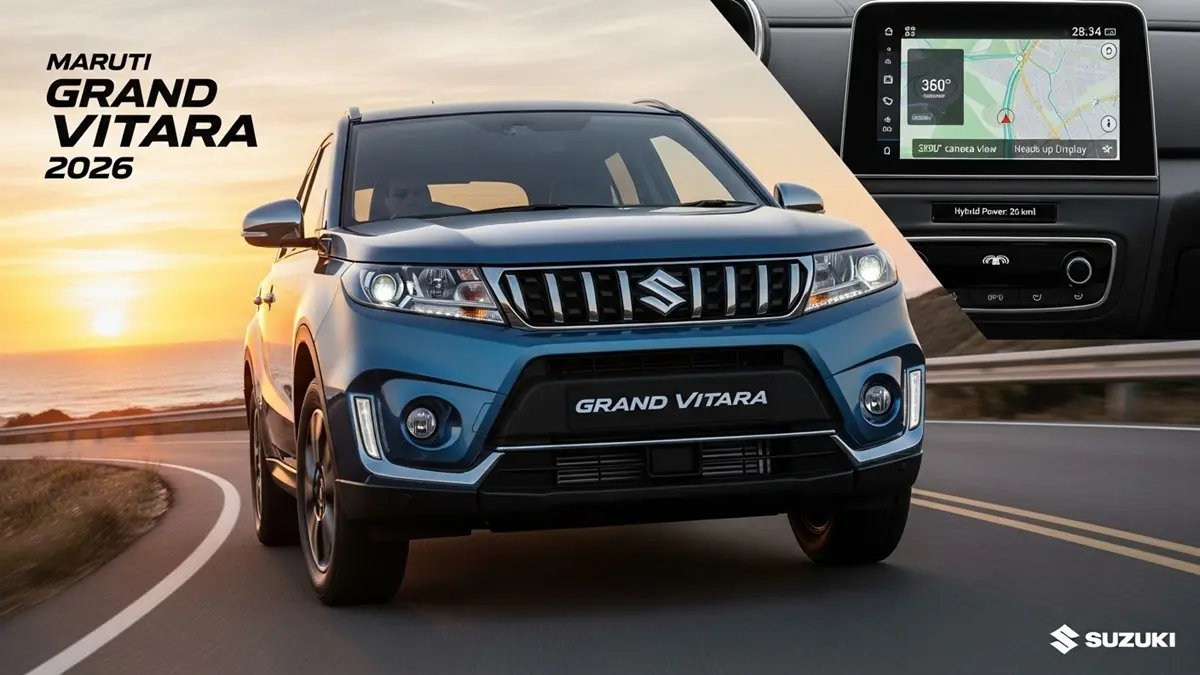
Maruti Grand Vitara has quietly become one of India’s favourite mid-size SUVs. Not because it’s the fastest or the flashiest, but because it does something that matters more to most families — it saves you money every single time you drive it.
I’ve spent time with the Grand Vitara across different variants — the mild hybrid, the strong hybrid, and the CNG. Through city traffic, highway cruises, and even some light off-roading with the AllGrip system. Here’s the honest, no-nonsense breakdown of what works, what doesn’t, and which version actually makes sense for you.
Design: Understated Elegance That Ages Well
The Grand Vitara isn’t trying to scream for attention. At 4,345 mm long and 1,795 mm wide, it’s got a clean, sophisticated design that looks premium without being flashy . The signature chrome grille, the sleek LED headlamps, and the muscular wheel arches give it a commanding presence.
What I appreciate is the ground clearance — 208-210 mm depending on the variant . That’s genuinely useful for Indian roads. You won’t be grinding your underbody on those unavoidable speed breakers. The 2,600 mm wheelbase translates into excellent rear legroom, which matters more than you think on long drives .
The dual-tone colour options — like Opulent Red with a black roof or Arctic White with a black roof — add some visual flair. The Nexa Blue is particularly striking if you want to stand out .
One thing to note: the strong hybrid variant has a slightly smaller boot (around 265 litres) because the battery pack sits under the floor . The mild hybrid and CNG variants offer more luggage space, though the CNG’s boot is compromised by the cylinder. More on that later.
Performance: Three Powertrains, Three Different Buyers
This is where the Grand Vitara gets interesting. Maruti offers three distinct powertrains, and each serves a different type of buyer. Let me break them down clearly.
1.5-litre Mild Hybrid (K15C) — 103 PS / 137-139 Nm
This is the “regular” Grand Vitara. The 1.5-litre 4-cylinder engine is smooth and refined — no vibrations like some 3-cylinder rivals. Power delivery is linear and predictable. It’s perfect for city driving where you don’t need sudden bursts of acceleration .
You get three transmission choices: a 5-speed manual, a 6-speed torque converter automatic (my pick for city driving), and a 6-speed automatic with AllGrip AWD for those who need off-road capability .
The mild hybrid system includes idle start-stop and brake regeneration. It helps with mileage, especially in traffic. But don’t expect EV-like performance — it’s a mild assist, not full electric driving.
1.5-litre Strong Hybrid — 116 PS / 141 Nm
This is the star of the lineup. The strong hybrid uses Toyota’s self-charging hybrid technology (the same system as the Toyota Hyryder). It combines a 1.5-litre 3-cylinder petrol engine with an electric motor and a small battery pack .
The e-CVT transmission is smooth as butter. In stop-and-go traffic, the car can run purely on electric power for short distances. That’s where the magic happens — you’re moving without burning any fuel. The transition between electric and petrol is seamless, almost unnoticeable.
Power is adequate, not exciting. If you’re coming from a turbo-petrol, you’ll find it a bit lazy. But that’s not the point. The strong hybrid is about efficiency, not speed. And on that front, it delivers spectacularly.

1.5-litre CNG — 88 PS / 121.5 Nm
This is for the high-mileage user. Power drops noticeably — you’ll feel it on inclines or when the car is fully loaded. The engine runs on CNG only (factory-fitted), so you can’t switch between fuels .
The CNG variant comes only with a 5-speed manual transmission. It’s not quick, but that’s not what it’s for. If you drive over 60-70 km daily, the fuel savings will make up for the lack of performance.
Mileage & Real-World Range: The Grand Vitara’s Superpower
This is why people buy the Grand Vitara. The ARAI-certified figures are genuinely impressive, and the real-world numbers hold up well too. Let me share the data:
Strong Hybrid (e-CVT): ARAI 27.97 km/l, Real-world 22-25 km/l . That’s not a typo. Twenty-five kilometres per litre in real-world driving from a petrol SUV. The strong hybrid can run on electric power at low speeds, which is why it’s so efficient in city traffic. One owner review on Autocar India mentioned that the Grand Vitara is “one of the most fuel efficient SUVs in the segment” .
Mild Hybrid Manual (5-speed): ARAI 21.11 km/l, Real-world 14-16 km/l . The gap between ARAI and real-world is larger here because the mild hybrid system doesn’t do as much heavy lifting as the strong hybrid.
Mild Hybrid Automatic (6-speed TC): ARAI 20.58 km/l, Real-world 12-14 km/l . The torque converter automatic is smooth but less efficient than the manual.
Mild Hybrid Automatic AWD: ARAI 19.20 km/l, Real-world 11-13 km/l . The AllGrip system adds weight and drivetrain losses, so efficiency takes a hit. But if you need AWD, the trade-off is worth it.
CNG (5-speed Manual): ARAI 26.60 km/kg, Real-world 21-23 km/kg . The CNG variant is remarkably efficient. At current CNG prices (around ₹76/kg in Delhi), the running cost is roughly ₹2.8-3.2 per kilometre. That’s less than half of what a petrol SUV costs to run.
The fuel tank holds 45 litres for the mild hybrid and strong hybrid variants . On the strong hybrid, a full tank gives you over 1,000 km of range in mixed driving. That’s Delhi to Jaipur and back without refuelling.
Interior & Features: Premium Where It Counts
Step inside the Grand Vitara, and the first thing you notice is how well laid out everything is. The dashboard is clean, the materials feel decent for the price, and the soft-touch surfaces on the doors and dashboard add a premium touch .
The base Sigma variant is functional but basic — you get manual AC, steel wheels, and a basic audio system. The Delta is where things start getting interesting, but the real action begins with the Zeta and Alpha trims .
The higher variants come loaded with features :

- 9-inch SmartPlay Pro+ touchscreen with wireless Android Auto and Apple CarPlay
- Panoramic sunroof — a rare feature in this segment
- Ventilated front seats — a blessing in Indian summers
- Wireless phone charger
- Head-up display (HUD) — shows speed, navigation, and hybrid info
- 360-degree camera — makes parking much easier
- 6-speaker Clarion sound system — decent, not exceptional
- Auto-dimming IRVM — no more blinding headlights from behind
- Rear sunshades — a thoughtful touch for passengers
The rear seat is spacious. The 2,600 mm wheelbase means even tall passengers won’t complain about legroom. Three adults can sit reasonably comfortably, though the middle seat is a bit firm.
The boot space is 373 litres on the mild hybrid and CNG variants . The strong hybrid’s boot is smaller at around 265 litres because the battery pack sits under the floor . If luggage space is a priority, stick to the mild hybrid or CNG.
What’s missing? Ventilated seats are only available on the front row — none for the rear. Also, no ADAS (Advanced Driver Assistance Systems) on the Grand Vitara. Rivals like the Hyundai Creta and Kia Seltos offer Level 2 ADAS on higher variants . If you want ADAS, you’ll need to look elsewhere.
Safety: 6 Airbags Standard, 4-Star Global NCAP
The Grand Vitara takes safety seriously. It comes with 6 airbags as standard across all variants — dual front, side, and curtain airbags . That’s not something every competitor can say at the base level.
Other standard safety features include :
- ABS with EBD
- Electronic Stability Program (ESP)
- Hill Hold Assist
- Rear parking sensors
- ISOFIX child seat mounts
- Seat belt reminder for all seats
- Speed-sensing auto door locks
Higher variants add a 360-degree camera, rear parking camera, and auto-dimming IRVM .
The Grand Vitara has a 4-star Global NCAP safety rating . That’s solid for a mid-size SUV. The body structure is reasonably strong, though it’s not as rigid as a Tata or Mahindra. For most city and highway driving, the 4-star rating and 6 airbags provide adequate protection.
One thing to note — the Grand Vitara does not offer ADAS. Rivals like the Hyundai Creta, Kia Seltos, and the new Renault Duster offer Level 2 ADAS on their higher variants . If you want adaptive cruise control, lane keep assist, or autonomous emergency braking, you’ll need to look at those options.
Price Structure (Ex-showroom, Delhi)
The 2026 Maruti Grand Vitara is available in a wide range of variants. Here’s the breakdown :
Mild Hybrid Petrol Manual (1.5L, 103 PS)
- Sigma: ₹10.77 lakh
- Delta: ₹12.10 lakh
- Zeta: ₹13.70 lakh
- Zeta DT (Dual Tone): ₹13.85 lakh
- Alpha: ₹15.20 lakh
- Alpha DT: ₹15.35 lakh
Mild Hybrid Petrol Automatic (6-speed TC)
- Delta: ₹13.45 lakh
- Zeta: ₹15.05 lakh
- Alpha: ₹16.55 lakh
Mild Hybrid Petrol Automatic AWD (AllGrip)

- Alpha: ₹18.00 lakh
- Alpha DT: ₹18.15 lakh
Strong Hybrid (e-CVT, 116 PS)
- Delta Plus: ₹16.63 lakh
- Zeta Plus: ₹17.92 lakh
- Alpha Plus: ₹19.50 lakh
- Alpha Plus DT: ₹19.66 lakh
CNG (5-speed Manual, 88 PS)
- Delta: ₹13.00 lakh
- Zeta: ₹14.60 lakh
- Zeta DT: ₹14.75 lakh
On-road prices add about ₹1.5-2.0 lakh depending on your city’s RTO and insurance costs. In Delhi, the base Sigma costs around ₹12.26 lakh on-road; the top Alpha Plus strong hybrid DT costs about ₹23.16 lakh on-road .
✅ Pros
- Strong hybrid delivers 22-25 km/l real-world mileage — best in class
- 6 airbags standard across all variants
- 4-star Global NCAP safety rating
- Smooth, refined driving experience — no vibrations
- Panoramic sunroof, ventilated seats, and head-up display available
- CNG option offers incredibly low running costs (~₹3 per km)
- AllGrip AWD available for rough-road capability
- Maruti’s massive service network and cheap spare parts
- Strong resale value — you won’t lose much when selling
❌ Cons
- No diesel or turbo-petrol option — rivals offer both
- No ADAS (Level 2 ADAS available on Creta, Seltos, Duster)
- Strong hybrid’s boot is small (265L) due to battery placement
- CNG variant loses almost all boot space (~150L)
- Engine feels underpowered for enthusiastic driving — no turbo
- Higher variants are priced close to premium SUVs
- 3-cylinder strong hybrid engine has some vibration at idle
Comparison Table: Maruti Grand Vitara vs Top Rivals
The Grand Vitara competes with the Hyundai Creta, Kia Seltos, and Honda Elevate in the mid-size SUV segment. Here’s how they stack up :
| Feature | Maruti Grand Vitara | Hyundai Creta | Kia Seltos | Honda Elevate |
|---|---|---|---|---|
| Price (ex-showroom) | ₹10.77 – ₹19.72 lakh | ₹10.79 – ₹20.20 lakh | ₹10.99 – ₹19.99 lakh | ₹11.60 – ₹16.59 lakh |
| Engine Options | 1.5L Petrol, Strong Hybrid, CNG | 1.5L NA, 1.5L Turbo, 1.5L Diesel | 1.5L NA, 1.5L Turbo, 1.5L Diesel | 1.5L NA Petrol only |
| Power (Top Petrol) | 116 PS (Strong Hybrid) | 160 PS (Turbo) | 160 PS (Turbo) | 121 PS |
| ARAI Mileage (Best) | 27.97 kmpl (Strong Hybrid) | 21.8 kmpl (Diesel) | 20.7 kmpl (Diesel) | 16.92 kmpl |
| Real-World City Mileage | 22-25 kmpl (Strong Hybrid) | 13-16 kmpl | 12-15 kmpl | 11-13 kmpl |
| Safety Rating | 4-star Global NCAP | 3-star Global NCAP | 4-star Bharat NCAP | Not tested |
| Airbags Standard | 6 | 6 | 6 | 6 |
| ADAS Available | No | Yes (Level 2) | Yes (Level 2) | Yes (select variants) |
| CNG Option | Yes (26.6 km/kg) | No | No | No |
| Best For | Fuel efficiency + low running costs + smooth hybrid driving | Turbo performance + diesel + ADAS features | Feature-loaded cabin + turbo + diesel | Spacious cabin + long-term reliability |
Which one should you pick? Here’s the honest answer.
If your priority is fuel efficiency and low running costs, the Grand Vitara strong hybrid is the clear winner. Nothing in the segment comes close to 22-25 km/l in real-world city driving. The smooth e-CVT transmission makes city traffic bearable, and the 1,000 km+ range means fewer trips to the petrol pump.
If you want turbo performance and ADAS features, the Hyundai Creta or Kia Seltos are better choices. The 1.5L turbo-petrol (160 PS) is genuinely fun to drive, and Level 2 ADAS adds a layer of safety on highways. But you’ll pay for it at the pump — expect 11-13 km/l in the city .
If you want a simple, reliable, no-nonsense SUV, the Honda Elevate is worth considering. The 1.5L 4-cylinder engine is smooth, the cabin is spacious, and Honda’s reliability is legendary. But the mileage is lower, and there’s no hybrid or CNG option.
For most buyers who drive primarily in the city and care about running costs, the Grand Vitara strong hybrid (Zeta Plus or Alpha Plus) is the smartest choice. The fuel savings over 5 years will be substantial, and the smooth hybrid driving experience is genuinely pleasant in traffic.
Frequently Asked Questions
A: The Maruti Grand Vitara is a petrol, strong hybrid, and CNG SUV. No diesel option is available. The engine is a 1.5-litre unit available in three states of tune: mild hybrid (103 PS), strong hybrid (116 PS), and CNG (88 PS) .
A: The strong hybrid delivers 22-25 km/l in real-world mixed driving. The ARAI-certified figure is 27.97 km/l, which is achievable under ideal conditions. In heavy city traffic with AC on, expect around 20-22 km/l .

A: Yes, the Maruti Grand Vitara comes with 6 airbags as standard across all variants — dual front, side, and curtain airbags .
A: The Grand Vitara has a 4-star Global NCAP safety rating. It has not been tested by Bharat NCAP yet .
A: The base Sigma variant costs around ₹12.26 lakh on-road in Delhi. The top Alpha Plus strong hybrid DT costs about ₹23.16 lakh on-road. Prices vary slightly by city due to RTO charges and insurance .
A: Yes, the Grand Vitara offers a panoramic sunroof from the Zeta variant onwards. It’s one of the few SUVs in this segment to offer a panoramic sunroof .
A: The Zeta Plus (Strong Hybrid) is the sweet spot. It gives you the panoramic sunroof, 9-inch touchscreen, wireless Android Auto/Apple CarPlay, ventilated seats, and the incredibly efficient strong hybrid powertrain — all for around ₹17.92 lakh ex-showroom .
A: The Toyota Hyryder is a mechanical twin of the Grand Vitara. Both share the same engines, platform, and features. The differences are styling (front grille, bumpers), colour options, and the service network. Choose whichever dealer is more convenient or offers a better price .
A: Yes, the Grand Vitara is very comfortable for highway drives. The seats are well-cushioned, the suspension absorbs bumps well, and the strong hybrid’s 45-litre fuel tank gives you over 1,000 km of range. The only caveat is that the engine isn’t very powerful for quick overtakes .
A: It depends on your priority. The Grand Vitara is better for fuel efficiency (strong hybrid), running costs, and smooth hybrid driving. The Creta is better for performance (160 PS turbo), ADAS features, and diesel option. Drive both and see which one you prefer .