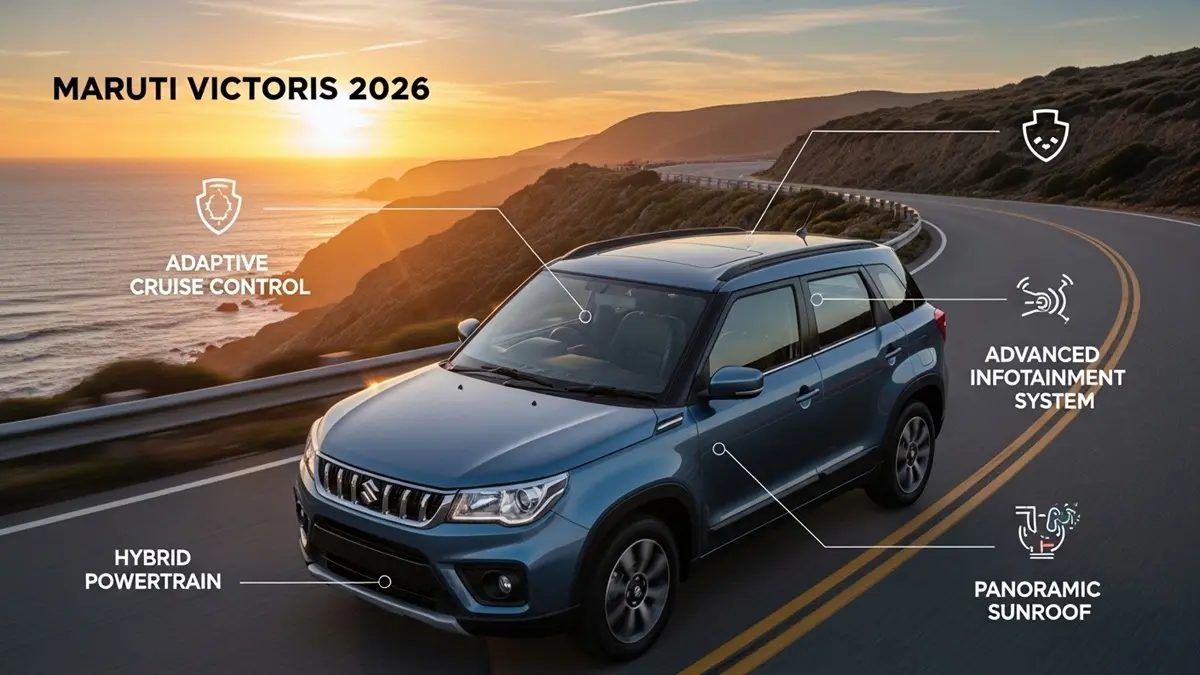
Maruti Victoris is a big deal. Not just because it’s Maruti’s flagship Arena SUV, but because it proves the company has finally figured out what modern Indian SUV buyers actually want — safety, efficiency, and features, all without breaking the bank.
I’ve driven the Victoris across all its powertrains — the mild hybrid, the strong hybrid, and the clever underbody CNG version. Through city traffic, on highways, and even on some rough patches where the 210 mm ground clearance came in handy. Here’s my honest, no-nonsense review.
Design: Aggressive, Modern, and Distinct
The Victoris doesn’t look like a Grand Vitara clone. It has its own personality — sharper, angrier, almost like it’s frowning at you. The front fascia is inspired by the upcoming e Vitara, with slim LED headlamps, connected DRLs, and a prominent Suzuki logo sitting above the ADAS sensors .
At 4,360 mm long and 1,795 mm wide, it’s actually longer than the Grand Vitara, which translates into a roomier cabin . The 210 mm ground clearance is excellent for Indian roads — you won’t be grinding your underbody on those unavoidable speed breakers .
The side profile is clean, with 17-inch dual-tone alloy wheels and rugged body cladding that adds to the SUV feel. At the rear, connected LED taillamps and a sporty roof spoiler with an integrated third brake light complete the package .
The powered tailgate with gesture control on higher variants is a genuinely useful feature. You know those times when your hands are full of groceries? A simple wave of your foot under the bumper opens the boot. Works like a charm .
Performance: Three Powertrains, Three Different Buyers
This is where the Victoris gets interesting. Maruti offers three distinct powertrains, and each serves a different type of buyer. Let me break them down.
1.5-litre Mild Hybrid (K15C) — 103 PS / 139 Nm
This is the “regular” Victoris. The 1.5-litre 4-cylinder engine is smooth and refined — no vibrations like some 3-cylinder rivals. Power delivery is linear and predictable. It’s perfect for city driving where you don’t need sudden bursts of acceleration .
You get two transmission choices: a 5-speed manual (my pick for driving feel) and a 6-speed torque converter automatic (my pick for city convenience). The torque converter is smooth — no AMT-style jerks here . There’s also an AWD option on higher variants for those who need off-road capability .
1.5-litre Strong Hybrid — 116 PS / 141 Nm
This is the star of the lineup. The strong hybrid uses Toyota’s self-charging hybrid technology (the same system as the Hyryder). It combines a 1.5-litre 3-cylinder petrol engine with an electric motor and a small battery pack .
The e-CVT transmission is smooth as butter. In stop-and-go traffic, the car can run purely on electric power for short distances. That’s where the magic happens — you’re moving without burning any fuel. The transition between electric and petrol is seamless, almost unnoticeable .
Power is adequate, not exciting. If you’re coming from a turbo-petrol, you’ll find it a bit lazy. But that’s not the point. The strong hybrid is about efficiency, not speed. And on that front, it delivers spectacularly.

1.5-litre CNG — 88 PS / 121 Nm
Here’s the clever bit. The Victoris CNG comes with an underbody-mounted CNG tank — a first in this segment . Unlike other CNG cars where the tank eats into boot space, the Victoris keeps its 439-litre boot almost entirely usable. That’s a game-changer for CNG buyers.
The CNG variant comes only with a 5-speed manual transmission. Power drops noticeably — you’ll feel it on inclines or when the car is fully loaded. But if you drive over 60-70 km daily, the fuel savings will make up for the lack of performance .
Mileage & Real-World Range: The Victoris’ Superpower
This is why people buy the Victoris. The ARAI-certified figures are genuinely impressive, and the real-world numbers hold up well too .
Strong Hybrid (e-CVT): ARAI 28.65 km/l, Real-world 22-25 km/l . That’s not a typo. Twenty-five kilometres per litre in real-world driving from a petrol SUV. The strong hybrid can run on electric power at low speeds, which is why it’s so efficient in city traffic.
Mild Hybrid Manual (5-speed): ARAI 21.18 km/l, Real-world 14-16 km/l . The gap between ARAI and real-world is larger here because the mild hybrid system doesn’t do as much heavy lifting as the strong hybrid.
Mild Hybrid Automatic (6-speed TC): ARAI 21.06 km/l, Real-world 12-14 km/l . The torque converter automatic is smooth but less efficient than the manual.
Mild Hybrid Automatic AWD: ARAI 19.07 km/l, Real-world 11-13 km/l . The AWD system adds weight and drivetrain losses, so efficiency takes a hit. But if you need AWD, the trade-off is worth it.
CNG (5-speed Manual): ARAI 27.02 km/kg, Real-world 21-23 km/kg . At current CNG prices (around ₹76/kg in Delhi), the running cost is roughly ₹3-3.5 per kilometre. That’s less than half of what a petrol SUV costs to run.
The fuel tank holds 45 litres . On the strong hybrid, a full tank gives you over 1,000 km of range in mixed driving. That’s Delhi to Jaipur and back without refuelling.
Interior & Features: Premium Where It Counts
Step inside the Victoris, and the first thing you notice is the dual-tone cabin — black and ivory on most variants, black with champagne gold accents on the strong hybrid .
The base LXI variant is functional but not barebones. It gets a 7-inch touchscreen with wireless Android Auto and Apple CarPlay, automatic AC, rear AC vents, push-button start, and — this is important — six airbags . That’s a lot of kit for the entry-level variant.

The higher variants (ZXI Plus onwards) come loaded with features :
- 10.1-inch touchscreen with wireless Android Auto and Apple CarPlay
- 10.25-inch digital driver’s display — clear and customisable
- Panoramic sunroof on ZXI(O) and ZXI Plus(O) variants
- Ventilated front seats — a blessing in Indian summers
- Head-up display (HUD) — shows speed, navigation, and hybrid info
- 360-degree camera with HD quality — makes parking much easier
- 8-speaker Infinity sound system with subwoofer — sounds genuinely good
- 64-colour ambient lighting — you can match the mood to your music
- AI-enabled Alexa voice assistant and Suzuki Connect with 60+ connected features
- Powered tailgate with gesture control — wave your foot, the boot opens
The rear seat is spacious. The 2,600 mm wheelbase means even tall passengers won’t complain about legroom. Three adults can sit reasonably comfortably, though the middle seat is a bit firm.
The boot space is 439 litres on the mild hybrid and strong hybrid variants — that’s class-leading . The CNG variant retains most of this space because of the underbody tank, which is a massive win over competitors where the CNG cylinder eats into luggage room .
What’s missing? Ventilated seats are only available on the front row — none for the rear. Also, no electric parking brake on lower variants (it’s available from ZXI onwards).
Safety: 5-Star Global NCAP — Maruti’s Safest SUV
This is the biggest news for the Victoris. It scored a 5-star Global NCAP safety rating for both adult and child occupant protection .
In the adult occupant test, the Victoris scored 33.72 points out of 34. The bodyshell integrity was rated stable and capable of withstanding further loadings. Frontal impact protection for the driver and co-driver was rated ‘good’ for most body regions .
In the child occupant test, it scored 41 points out of 49, earning a perfect 5-star rating. The child restraint system scored full points, and side protection for both the 18-month-old and 3-year-old dummies was perfect .
The Victoris also scored a 5-star Bharat NCAP safety rating, with 31.66 points out of 32 for adult safety and 43 out of 49 for child protection .
Standard safety equipment across all variants includes :
- 6 airbags (dual front, side, and curtain) — standard on all variants
- ABS with EBD and brake assist
- Electronic Stability Program (ESP)
- Traction control system (ASR/TCS)
- Hill Hold Assist
- Rear parking sensors
- ISOFIX child seat mounts
- 3-point seatbelts with reminders for all seats
- Tyre Pressure Monitoring System (TPMS)
- Disc brakes on all four wheels
Higher variants (ZXI Plus onwards) add :
- Level 2 ADAS — a first for a Maruti SUV. This includes adaptive cruise control, forward collision warning, autonomous emergency braking, lane departure warning, lane keep assist, and high beam assist .
- 360-degree camera with HD quality
- Electronic parking brake with auto hold
The 5-star rating puts the Victoris among the safest cars in its segment. Along with the Dzire, it’s one of only two Maruti models to achieve this score . For buyers who previously hesitated to buy a Maruti because of safety concerns, the Victoris removes that objection completely.

Price Structure (Ex-showroom, Delhi)
The 2026 Maruti Victoris is available in a wide range of variants. Here’s the breakdown based on variant-wise feature analysis :
Mild Hybrid Petrol (1.5L, 103 PS)
- LXI (Manual): ₹10.50 lakh
- VXI (Manual): ₹11.79 lakh
- VXI (Automatic – Torque Converter): ₹13.35 lakh
- ZXI (Manual): ₹13.56 lakh
- ZXI (Automatic): ₹15.12 lakh
- ZXI (O) (Manual): ₹14.07 lakh
- ZXI (O) (Automatic): ₹15.63 lakh
- ZXI Plus (Manual): ₹15.23 lakh
- ZXI Plus (Automatic): ₹17.18 lakh
- ZXI Plus AWD (Automatic): ₹18.63 lakh
- ZXI Plus (O) (Manual): ₹15.81 lakh
- ZXI Plus (O) (Automatic): ₹17.76 lakh
- ZXI Plus (O) AWD (Automatic): ₹19.21 lakh
CNG (1.5L, 88 PS, Manual only)
- LXI CNG: ₹11.49 lakh
- VXI CNG: ₹12.79 lakh
- ZXI CNG: ₹14.56 lakh
Strong Hybrid (e-CVT, 116 PS)
- VXI Strong Hybrid: ₹16.37 lakh
- ZXI Strong Hybrid: ₹17.79 lakh
- ZXI (O) Strong Hybrid: ₹18.38 lakh
- ZXI Plus Strong Hybrid: ₹19.46 lakh
- ZXI Plus (O) Strong Hybrid: ₹19.99 lakh
On-road prices add about ₹1.5-2.0 lakh depending on your city’s RTO and insurance costs. In Delhi, the base LXI costs around ₹12 lakh on-road; the top ZXI Plus (O) Strong Hybrid costs about ₹23.5 lakh on-road.
✅ Pros
- 5-star Global NCAP safety rating — first Maruti SUV to achieve this
- 6 airbags standard across all variants
- Strong hybrid delivers 22-25 km/l real-world mileage — best in class
- Level 2 ADAS available on higher variants — first Maruti with ADAS
- Underbody CNG tank preserves boot space — segment-first
- Spacious 439-litre boot on petrol/hybrid variants
- 210 mm ground clearance handles Indian roads well
- Powered tailgate with gesture control on higher variants
- Maruti’s massive service network and cheap spare parts
- Strong resale value — you won’t lose much when selling
- Sold 50,000+ units in first 4 months — clear customer acceptance
❌ Cons
- No diesel or turbo-petrol option — rivals offer both
- Engine feels underpowered for enthusiastic driving — no turbo
- Strong hybrid’s 3-cylinder engine has some vibration at idle
- Ventilated seats only available on front row
- Higher variants are priced close to premium SUVs
- No panoramic sunroof on strong hybrid variants (only on mild hybrid)
- Manual IRVM on lower variants (auto-dimming only on higher trims)
Comparison Table: Maruti Victoris vs Top Rivals
The Victoris competes with the Hyundai Creta, Kia Seltos, and Tata Sierra in the mid-size SUV segment . Here’s how they stack up:
| Feature | Maruti Victoris | Hyundai Creta | Kia Seltos | Tata Sierra |
|---|---|---|---|---|
| Price (ex-showroom) | ₹10.50 – ₹19.99 lakh | ₹10.79 – ₹20.20 lakh | ₹10.99 – ₹20.19 lakh | ₹11.49 – ₹21.29 lakh |
| Engine Options | 1.5L Petrol, Strong Hybrid, CNG | 1.5L NA, 1.5L Turbo, 1.5L Diesel | 1.5L NA, 1.5L Turbo, 1.5L Diesel | 1.5L NA, 1.5L Turbo, 1.5L Diesel |
| Power (Top Petrol) | 116 PS (Strong Hybrid) | 160 PS (Turbo) | 160 PS (Turbo) | 158 PS (Turbo) |
| ARAI Mileage (Best) | 28.65 kmpl (Strong Hybrid) | 21.8 kmpl (Diesel) | 20.7 kmpl (Diesel) | ~22 kmpl (Diesel est.) |
| Real-World City Mileage | 22-25 kmpl (Strong Hybrid) | 13-16 kmpl | 12-15 kmpl | 14-17 kmpl (est.) |
| Safety Rating | 5-star Global NCAP | 3-star Global NCAP | 4-star Bharat NCAP | Not tested yet |
| Airbags Standard | 6 | 6 | 6 | 6 |
| ADAS Available | Yes (Level 2) | Yes (Level 2) | Yes (Level 2) | No |
| CNG Option | Yes (27.02 km/kg, underbody tank) | No | No | No |
| Boot Space | 439 litres (petrol/hybrid) | 433 litres | 447 litres | 622 litres |
| Best For | Fuel efficiency + 5-star safety + CNG practicality | Turbo performance + diesel + ADAS features | Feature-loaded cabin + turbo + diesel | Boot space + build quality + diesel |
Which one should you pick? Here’s the honest answer.
If your priority is fuel efficiency and low running costs, the Victoris strong hybrid is the clear winner. Nothing in the segment comes close to 22-25 km/l in real-world city driving. The 5-star safety rating and Level 2 ADAS on higher variants make it a complete package .
If you want turbo performance and a diesel option, the Hyundai Creta or Kia Seltos are better choices. The 1.5L turbo-petrol (160 PS) is genuinely fun to drive, and the diesel option is still available. But you’ll pay for it at the pump — expect 11-13 km/l in the city.
If you want maximum boot space and a diesel engine, the Tata Sierra’s 622-litre boot is class-leading . It also has a diesel option, which the Victoris lacks. But the Victoris wins on safety rating and fuel efficiency.

For most buyers who drive primarily in the city and care about running costs, the Victoris strong hybrid (ZXI or ZXI Plus) is the smartest choice. The fuel savings over 5 years will be substantial, and the 5-star safety rating gives genuine peace of mind.
Frequently Asked Questions
A: The Maruti Victoris is a petrol, strong hybrid, and CNG SUV. No diesel option is available. The engine is a 1.5-litre unit available in three states of tune: mild hybrid (103 PS), strong hybrid (116 PS), and CNG (88 PS) .
A: The strong hybrid delivers 22-25 km/l in real-world mixed driving. The ARAI-certified figure is 28.65 km/l, which is achievable under ideal conditions. In heavy city traffic with AC on, expect around 20-22 km/l .
A: Yes, the Maruti Victoris comes with 6 airbags as standard across all variants — dual front, side, and curtain airbags .
A: The Victoris has a 5-star Global NCAP safety rating and a 5-star Bharat NCAP safety rating — the first Maruti SUV to achieve this .
A: The base LXI variant costs around ₹12 lakh on-road in Delhi. The top ZXI Plus (O) Strong Hybrid costs about ₹23.5 lakh on-road. Prices vary slightly by city due to RTO charges and insurance.
A: Yes, the Maruti Victoris offers a panoramic sunroof on ZXI(O) and ZXI Plus(O) variants. However, the strong hybrid variants do not get the panoramic sunroof — only the mild hybrid variants do .
A: The ZXI Plus (Mild Hybrid Automatic) is the sweet spot for most buyers. It gives you the 10.1-inch touchscreen, 360-degree camera, ventilated seats, head-up display, Level 2 ADAS, and the smooth 6-speed torque converter automatic — all for around ₹17.18 lakh ex-showroom . If you drive a lot, the ZXI Strong Hybrid is worth the extra for the fuel savings.
A: The Victoris is Maruti’s Arena-branded mid-size SUV, while the Grand Vitara is sold through the premium Nexa channel. The Victoris is slightly longer (4,360 mm vs 4,355 mm) and gets a more aggressive front design. Mechanically, they share the same engines, platforms, and features. The Victoris is also slightly more affordable at the entry level .
A: Yes, the Victoris is very comfortable for highway drives. The seats are well-cushioned, the suspension absorbs bumps well, and the strong hybrid’s 45-litre fuel tank gives you over 1,000 km of range. The Level 2 ADAS on higher variants makes highway cruising less tiring. The only caveat is that the engine isn’t very powerful for quick overtakes.
A: It depends on your priority. The Victoris is better for fuel efficiency (strong hybrid), safety (5-star NCAP), and CNG practicality. The Creta is better for performance (160 PS turbo), diesel option, and ADAS features (though Victoris also has ADAS on higher variants). Drive both and see which one you prefer .