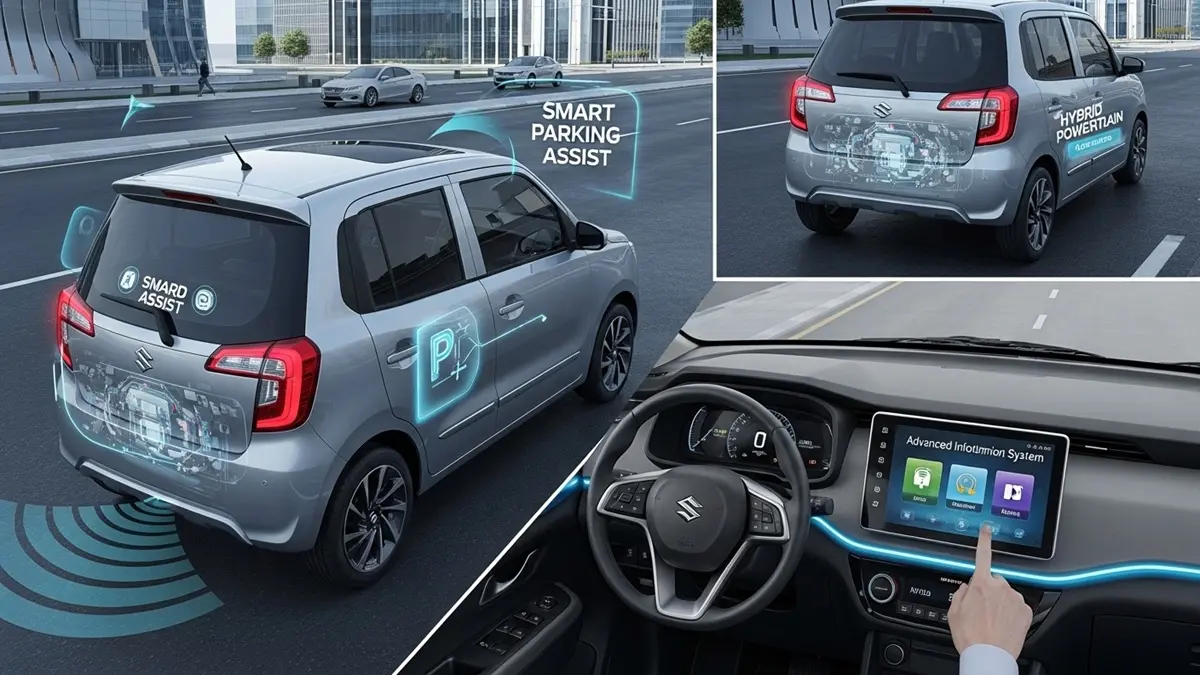
Maruti Wagon R has been a household name in India for over two decades. That tall-boy silhouette, the massive headroom, the feeling of sitting upright like you’re in a small SUV — it’s a design that was mocked at first, then copied, and now celebrated.
In 2026, the Wagon R continues its journey. It’s not the newest kid on the block, and it won’t win any beauty contests. But for middle-class families upgrading from a two-wheeler, or for anyone who values space and running costs over style, this car still makes a lot of sense. I’ve spent time with the latest model, driving it through city chaos and on highways. Here’s my honest, ground-level review.
Design: The Original Tall-Boy, Still Standing
Let’s be honest — the Wagon R isn’t winning any design awards. It’s boxy, upright, and unapologetically functional. At 3,655 mm long and 1,620 mm wide, it’s compact enough for city parking, but the 1,675 mm height is where the magic happens .
That height translates directly into headroom. You sit upright, almost like you’re in a small SUV. Your legs don’t stretch out in front of you; they drop down naturally. For older passengers or anyone with back issues, this is genuinely more comfortable than a low-slung hatchback.
The 2026 model gets minor updates — a refreshed grille, sleeker headlamps on higher variants, and new alloy wheel designs on the top trims . But don’t expect a revolution. The Wagon R looks like a Wagon R. It’s functional, not fashionable. If you’re young and care about street cred, this probably isn’t your car. If you’re a parent who needs to drop kids to school and pick up groceries, you won’t care what it looks like.
Ground clearance is 170 mm, which is decent for Indian roads . You won’t scrape every speed breaker, but you’ll still want to slow down for the nasty ones. The turning radius of 4.7 metres makes U-turns manageable in city traffic .
Performance: Two Engines, City-Focused Tuning
Maruti offers two petrol engines on the Wagon R, and both are tuned for city driving. Let me break them down.
1.0-litre K10C Petrol (66 bhp / 89 Nm)
This is the volume seller. It’s a 3-cylinder engine, so there’s some vibration at idle — you’ll feel it if you’re coming from a 4-cylinder car. But once you’re moving, it’s smooth enough. Power delivery is linear and predictable. In city traffic, you don’t need to rev it hard. The clutch is light, and the gearbox is typical Maruti — slick and easy to use .
The 5-speed manual is my pick for driving feel. The AMT (Auto Gear Shift) is available on higher variants. It’s convenient for stop-and-go traffic, but it can feel jerky if you’re heavy on the throttle. Drive it gently, and it’s perfectly acceptable .
On the highway, the 1.0-litre engine feels strained above 90 km/h. Overtaking requires planning and downshifting. But let’s be real — this car isn’t meant for highway cruising. It’s a city car, and in that environment, it works.
1.2-litre K12N Petrol (88 bhp / 113 Nm)
This engine is only available on the top ZXI and ZXI+ variants . It’s a 4-cylinder unit, so it’s smoother than the 1.0-litre. No vibrations at idle. The extra power makes a noticeable difference — the car feels more eager, and highway overtakes are less stressful .
If your budget allows, the 1.2-litre is worth the upgrade. It’s not fast by any means, but it’s adequate. The fuel efficiency penalty is minimal — you’ll lose about 1-2 km/l compared to the 1.0-litre.

1.0-litre CNG (56 bhp / 82 Nm)
This is for the high-mileage user. The CNG variant comes only with the 5-speed manual transmission . Power drops noticeably — you’ll feel it on inclines or when the car is fully loaded. The engine feels lazy, and you’ll need to downshift more often.
But here’s the thing — if you drive over 50 km daily, the fuel savings are massive. More on that in the mileage section. The CNG tank is underbody-mounted, which means the boot space is preserved. That’s a clever design choice.
Mileage & Real-World Range: The Wagon R’s Superpower
This is why people buy the Wagon R. The fuel efficiency is genuinely impressive. But let me give you real numbers, not just ARAI claims.
1.0L Petrol Manual: ARAI claims 24.35 km/l. In the real world, expect 14-16 km/l in city traffic and 18-20 km/l on highways . The automatic version gives slightly lower city mileage — around 13.5-15 km/l — because the AMT holds gears a bit longer .
1.2L Petrol Manual: ARAI claims 23.56 km/l. Realistically, expect 13-15 km/l in city and 17-19 km/l on highways . The extra power comes with a small efficiency penalty.
1.0L CNG Manual: ARAI claims 34.05 km/kg. In the real world, expect 22-24 km/kg in city traffic and 26-28 km/kg on highways . Some owners report even higher figures with gentle driving — up to 31 km/kg on open highways .
The petrol tank holds 32 litres . On the 1.0L petrol manual, a full tank gives you a city range of 450-500 km and a highway range of over 600 km. The CNG tank holds about 8-9 kg of gas, giving you 200-240 km of pure CNG range before it switches to petrol .
Running cost comparison (Delhi prices: petrol ~₹95/litre, CNG ~₹80/kg):
- 1.0L Petrol Manual: Roughly ₹5.6-6.8 per kilometre
- 1.0L CNG Manual: Roughly ₹2.8-3.6 per kilometre
If you drive 1,500 km a month, the CNG variant saves you about ₹4,500-5,000 every single month . Over five years, that’s over ₹2.5 lakh in savings. The upfront CNG premium (about ₹90,000) is recovered in roughly 20 months .
A few things that affect mileage: heavy AC usage drops efficiency by 1-2 km/l. Aggressive driving with sudden acceleration also hurts. Under-inflated tyres can cost you another 1-2 km/l . Keep these in check, and the Wagon R will treat your wallet well.
Interior & Features: Practical, Not Premium
Step inside the Wagon R, and the first thing you notice is the space. The tall-boy design delivers on its promise — headroom is class-leading. Even tall passengers won’t bump their heads. The rear seat is spacious enough for three adults, though the middle seat is a bit firm.

The dashboard is functional, with hard plastics everywhere. The base LXI variant is very barebones — no touchscreen, steel wheels, basic audio system. The VXI is where the Wagon R starts making sense. It gets a 7-inch touchscreen with Android Auto and Apple CarPlay on higher variants, manual climate control, and keyless entry .
The ZXI and ZXI+ variants add LED headlamps, alloy wheels, rear wiper, rear defogger, and a more premium audio system . The top ZXI+ Dual Tone gets the 1.2-litre engine and two-tone paint options.
What’s missing? The interior quality is average — lots of hard plastic. There’s no automatic climate control, even on the top variant (it’s manual AC). No rear AC vents. No sunroof. No ventilated seats. This is not a premium car. It’s a practical car.
The boot space is 341 litres on petrol variants . That’s enough for three suitcases or a week’s grocery run for a family of four. The CNG variant’s boot is smaller because of the underbody tank — you lose some depth, but it’s still usable for soft bags .
Safety: Finally, 6 Airbags Standard
This is the biggest improvement for 2026. Maruti has made 6 airbags standard across all Wagon R variants — dual front, side, and curtain airbags . That’s a significant upgrade from the older models that had only two.
Other standard safety features include :
- ABS with EBD
- Electronic Stability Program (ESP)
- Rear parking sensors (only rear, no camera on lower variants)
- ISOFIX child seat mounts
- Speed-sensing auto door locks
- Seat belt reminder for all seats
Now, here’s the honest truth. The Wagon R has a 2-star Global NCAP safety rating . That’s not great. The body structure is lightweight (kerb weight around 835-840 kg) , which helps with mileage but not with crash protection.
The 6 airbags are a significant improvement. In a crash, they will protect you much better than two. But the underlying structure is still not as strong as a Tata Tiago (which has a 4-star rating). If safety is your absolute priority, spend more money on a safer car.
But for city driving at moderate speeds — which is what the Wagon R is designed for — the 6 airbags provide adequate protection. And at this price point, no other car offers 6 airbags as standard across all variants.
Price Structure (Ex-showroom, Delhi)
The 2026 Maruti Wagon R is available in multiple variants. Here’s the breakdown :
- LXI 1.0L (Petrol Manual): ₹4.99 lakh
- VXI 1.0L (Petrol Manual): ₹5.52 lakh (approx)
- LXI 1.0L CNG (Manual): ₹5.64 lakh (approx)
- VXI 1.0L AT (Petrol Automatic): ₹6.22 lakh (approx)
- VXI 1.0L CNG (Manual): ₹6.42 lakh (approx)
- ZXI 1.2L (Petrol Manual): ₹6.50 lakh (approx)
- ZXI 1.2L AT (Petrol Automatic): ₹6.95 lakh (approx)
- ZXI+ 1.2L (Petrol Manual): ₹6.95 lakh (approx)
- ZXI+ 1.2L AT (Petrol Automatic): ₹7.35 lakh (approx)
- ZXI+ 1.2L Dual Tone (Petrol Manual): ₹7.15 lakh (approx)
- ZXI+ 1.2L AT Dual Tone (Petrol Automatic): ₹7.80 lakh (approx)
On-road prices add about ₹50,000-80,000 depending on your city’s RTO and insurance costs. In Delhi, the base LXI costs around ₹5.43 lakh on-road; the top ZXI+ 1.2L AT Dual Tone costs about ₹8.50 lakh on-road .

The CNG variants cost about ₹80,000-1,00,000 more than their petrol counterparts. As I mentioned earlier, the fuel savings recover that difference within two years of regular driving .
✅ Pros
- Excellent fuel efficiency — 14-20 km/l petrol, 23-31 km/kg CNG
- 6 airbags now standard across all variants
- Tall-boy design offers class-leading headroom and cabin space
- Spacious 341-litre boot on petrol variants
- Maruti’s massive service network and cheap spare parts
- Strong resale value — you won’t lose much when selling
- CNG option offers incredibly low running costs (₹2.8-3.6 per km)
- Light steering and compact size make city driving effortless
- Underbody CNG tank preserves boot space
- Affordable entry price — one of the cheapest cars in India
❌ Cons
- 2-star Global NCAP rating — structure isn’t very strong
- Boxy design feels outdated — won’t appeal to younger buyers
- Base variants miss basic features like touchscreen and alloy wheels
- Three-cylinder engine (1.0L) has vibrations at idle
- High-speed stability on highways is not confidence-inspiring
- No rear AC vents, no automatic climate control, no sunroof
- Interior uses hard plastics — doesn’t feel premium
- AMT gearbox can feel jerky in stop-and-go traffic
Comparison Table: Maruti Wagon R vs Top Rivals
The Wagon R competes with the Tata Tiago, Renault Kwid, and Maruti Celerio in the entry-level hatchback segment. Here’s how they stack up :
| Feature | Maruti Wagon R | Tata Tiago | Renault Kwid | Maruti Celerio |
|---|---|---|---|---|
| Price (ex-showroom) | ₹4.99 – ₹7.80 lakh | ₹4.57 – ₹7.82 lakh | ₹4.30 – ₹5.99 lakh | ₹4.70 – ₹6.73 lakh |
| Engine | 1.0L 3-cyl / 1.2L 4-cyl | 1.2L 3-cyl, 85 bhp | 1.0L 3-cyl, 67 bhp | 1.0L 3-cyl, 66 bhp |
| Power (Top) | 88 bhp (1.2L) | 85 bhp | 67 bhp | 66 bhp |
| Real Mileage (City) | 14-16 km/l (Petrol) | 12-14 km/l | 12-14 km/l | 18-20 km/l |
| CNG Mileage (Real) | 23-31 km/kg | 18-22 km/kg | No factory CNG | 24-30 km/kg |
| Safety Rating | 2-star Global NCAP | 4-star Global NCAP | 1-star Global NCAP | Not tested |
| Airbags Standard | 6 | 6 | 2 (6 on higher variants) | 2-6 (varies) |
| Boot Space | 341 litres | 242 litres | 279 litres | 313 litres |
| Ground Clearance | 170 mm | 170 mm | 184 mm | 170 mm |
| Best For | Headroom + CNG savings + 6 airbags | Safety + build quality + style | High ground clearance + budget price | Fuel efficiency + sleek design |
Which one should you pick? Here’s the honest answer.
If your priority is cabin space, fuel efficiency, and low running costs, the Wagon R is the clear winner. The tall-boy design offers headroom that no rival can match. The CNG variant is one of the most economical cars to run. And with 6 airbags now standard, safety is no longer a deal-breaker.
If safety and build quality are your absolute priorities, the Tata Tiago’s 4-star Global NCAP rating is the best in class. The Tiago also has a more modern design and better interior quality. But the mileage is lower, and the boot is smaller.
If you want high ground clearance and a budget price, the Renault Kwid is worth considering. At 184 mm, it sits higher than the Wagon R. But the safety rating is poor (1-star), and there’s no factory CNG option.
If you want maximum fuel efficiency in a sleeker package, the Maruti Celerio is an interesting alternative. It shares the same 1.0-litre engine as the Wagon R but is more aerodynamic, so it returns slightly better mileage. But the headroom is lower, and the cabin feels more cramped.
For most buyers who want a practical, fuel-efficient, and now safer family car, the Wagon R is still the smartest choice. The VXI 1.0L (Petrol Manual) is the sweet spot for city drivers. If you drive a lot, the VXI CNG is worth the extra upfront cost.
Frequently Asked Questions
A: The Maruti Wagon R is a petrol and CNG car only. No diesel option is available. Two petrol engines are offered: 1.0-litre (66 bhp) and 1.2-litre (88 bhp) .
A: The 1.0L petrol manual gives 14-16 km/l in city traffic with AC on. The AMT gives 13.5-15 km/l. The 1.2L petrol gives 13-15 km/l. The CNG variant delivers 22-24 km/kg in the city and 26-28 km/kg on highways .

A: Yes, the 2026 Maruti Wagon R comes with 6 airbags as standard across all variants — dual front, side, and curtain airbags .
A: The Wagon R has a 2-star Global NCAP safety rating . The 6 airbags improve protection, but the underlying body structure is lightweight. For city driving at moderate speeds, it’s acceptable.
A: The base LXI variant costs around ₹5.43 lakh on-road in Delhi. The top ZXI+ 1.2L AT Dual Tone costs about ₹8.50 lakh on-road. Prices vary slightly by city due to RTO charges and insurance .
A: No, the Maruti Wagon R does not offer a sunroof in any variant. At this price point, that’s expected.
A: The VXI 1.0L (Petrol Manual) is the sweet spot. It gives you the 7-inch touchscreen (on higher variants), keyless entry, rear parking sensors, and 6 airbags — all for around ₹5.52 lakh ex-showroom. If you drive a lot, the VXI CNG is worth the extra ₹90,000 for the fuel savings .
A: The 1.2-litre engine is a 4-cylinder unit that produces 88 bhp (compared to 66 bhp in the 1.0L 3-cylinder). It’s smoother, has no idle vibrations, and offers better highway performance. The 1.2L is only available on ZXI and ZXI+ variants .
A: It’s acceptable for occasional highway trips up to 300-400 km. The seats are comfortable, and the 32-litre fuel tank gives you over 600 km of highway range on the 1.0L petrol. But high-speed stability isn’t its strong suit, and the engine feels strained above 90 km/h. It’s primarily a city car .
A: It depends on your priority. The Wagon R is better for headroom, cabin space, and a more upright driving position. The Celerio is better for fuel efficiency (slightly higher), sleeker design, and a more modern interior. Drive both and see which one you prefer .