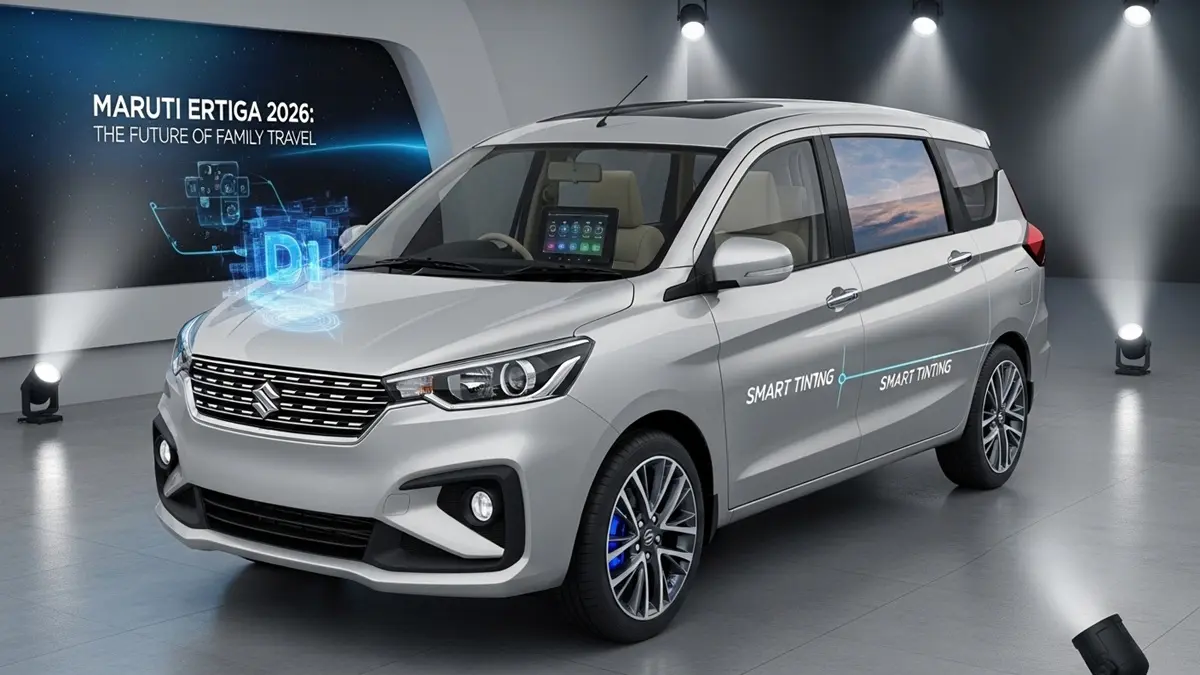
Maruti Ertiga has been India’s favourite family car for over a decade. In the first quarter of FY2026 alone, it sold 46,071 units — that’s a 6 per cent increase over the previous year, and enough to make it the best-selling MPV in the country . Not bad for a car that some people call “boring.”
I’ve spent time with the latest Ertiga, driving it through city traffic, on highways, and with a full load of passengers. Here’s the honest truth — this car isn’t trying to be exciting. It’s trying to be practical, fuel-efficient, and reliable. And on those fronts, it still delivers.
Design: Practical, Not Pretty
The Ertiga has never been a head-turner. And the 2026 model doesn’t change that formula. It’s 4,395 mm long, 1,735 mm wide, and 1,690 mm tall — dimensions that prioritise interior space over style .
The front gets a chrome-accented grille and swept-back headlamps. The side profile is clean, with a strong character line running from the front fender to the tail lights. The rear is upright, which maximises boot space. Nothing flashy, nothing offensive.
Ground clearance is 185 mm, which is adequate for most Indian roads . You won’t scrape every speed breaker, but you’ll still want to slow down for the nasty ones. The turning radius is 5.2 metres, which is decent for a car this long .
Higher variants get 15-inch alloy wheels, LED fog lamps, roof rails, and body-coloured bumpers . The dual-tone colour options — like Pearl Metallic Auburn Red and Oxford Blue — add some visual interest. But let’s be honest — you’re not buying an Ertiga for its looks. You’re buying it for what’s inside.
Interior & Practicality: The Real Star
Step inside the Ertiga, and the first thing you notice is the space. The 2,740 mm wheelbase translates into genuine room for seven people . Not “seven if two are children” — actually seven.
The first two rows are genuinely comfortable. The seats are well-cushioned, and the fabric upholstery breathes well in Indian summers. The driver’s seat gets manual slide and recline adjustment, which is fine for a car at this price point .
The second row has generous legroom and headroom. The seats can slide and recline, so passengers can find their comfort zone. There are rear AC vents — a blessing in Indian summers — and a 12V charging outlet for the second row .
The third row is where the Ertiga stands out. Unlike some “7-seaters” that have a third row suitable only for children, the Ertiga’s third row can accommodate adults for short to medium trips. Legroom is tight, but it’s usable. The 50:50 split folding mechanism means you can fold one seat and still carry six people with some luggage .
Boot space is 209 litres with all three rows up . That’s enough for a few soft bags or a weekly grocery run. Fold the third row, and you get a cavernous cargo area. The CNG variant’s boot is smaller because of the underbody tank — you lose some depth, but it’s still usable for soft bags .
The dashboard is functional, with hard plastics everywhere. The base LXI variant is barebones — no touchscreen, steel wheels, basic audio system. The VXI is where the Ertiga starts making sense. It gets a 7-inch touchscreen with Android Auto and Apple CarPlay on higher variants, steering-mounted audio controls, and keyless entry .

The ZXI and ZXI+ variants add a 10.1-inch touchscreen, a digital instrument cluster, cruise control, a rear wiper, and auto-dimming IRVM . The top ZXI+ also gets LED projector headlamps and a more premium interior trim.
What’s missing? Ventilated seats, a sunroof (not available on any variant), and automatic climate control. At this price point, those are reasonable omissions.
Performance: The Trusted K15C Engine
Under the bonnet sits Maruti’s 1.5-litre K15C Smart Hybrid petrol engine. It produces 103 bhp at 6,000 rpm and 136.8 Nm of torque at 4,400 rpm . These numbers won’t win any drag races. But that’s not the point.
The engine is a 4-cylinder unit, which means it’s smooth and refined. No vibrations like some 3-cylinder rivals. Power delivery is linear — no sudden surges, no frustrating lag. In city traffic, it’s effortless.
You have two gearbox options. The 5-speed manual is slick and easy to use — classic Maruti. The 6-speed torque converter automatic is the better choice for city driving. It’s smooth, responsive, and doesn’t have the jerky behaviour of an AMT . Paddle shifters are available on the automatic variant for those who want a bit more control .
The Smart Hybrid system includes idle start-stop and brake regeneration. It helps with mileage, especially in traffic. The electric motor provides a small torque assist during acceleration, which makes the car feel slightly more responsive than the numbers suggest.
On the highway, the Ertiga cruises comfortably at 100-110 km/h. Overtaking requires planning, but it’s not stressful. The car feels stable at high speeds, and the suspension absorbs bumps reasonably well. It’s not a driver’s car, but it’s a competent family car.
CNG Variant: The CNG version uses the same engine but produces 87.8 bhp and 121.5 Nm of torque when running on gas . Power drops noticeably — you’ll feel it on inclines or when the car is fully loaded. The engine feels lazy, and you’ll need to downshift more often. But if you drive a lot, the fuel savings make it worth the compromise. The CNG variant is only available with the 5-speed manual transmission .
Mileage & Real-World Range: The Ertiga’s Superpower
This is why people buy the Ertiga. The ARAI-certified figures are impressive, and the real-world numbers hold up well too .
Official ARAI Figures:
- Petrol Manual: 20.51 km/l
- Petrol Automatic: 20.30 km/l
- CNG Manual: 26.11 km/kg
Real-World Mileage (with AC):

- Petrol Manual in city: 14-16 km/l
- Petrol Manual on highway: 16-18 km/l
- Petrol Automatic in city: 13-15 km/l
- Petrol Automatic on highway: 15-17 km/l
- CNG in city: 22-24 km/kg
- CNG on highway: 24-26 km/kg
The fuel tank holds 45 litres . On the petrol manual, a full tank gives you a city range of 600-650 km and a highway range of over 700 km. The CNG tank holds about 8-9 kg of gas, giving you 200-240 km of pure CNG range .
Running cost comparison (Delhi prices: petrol ~₹95/litre, CNG ~₹80/kg):
- Petrol Manual: Roughly ₹5.6-6.8 per kilometre
- CNG Manual: Roughly ₹3.0-3.6 per kilometre
The CNG premium is about ₹91,000 over the petrol variant . If you drive 1,500 km a month, the CNG saves you roughly ₹4,375 every month. The premium is recovered in about 21 months . Over five years, the savings exceed ₹2.5 lakh.
A few things that affect mileage: heavy AC usage drops efficiency by 1-2 km/l. Aggressive driving also hurts. Under-inflated tyres can cost you another 1-2 km/l. Keep these in check, and the Ertiga will treat your wallet well.
Safety: 6 Airbags Standard, 3-Star GNCAP
The 2026 Ertiga comes with 6 airbags as standard across all variants — dual front, side, and curtain airbags . That’s a significant upgrade from the older models that had only two.
Other standard safety features include :
- ABS with EBD and Brake Assist
- Electronic Stability Program (ESP)
- Hill Hold Assist
- Rear parking sensors
- ISOFIX child seat mounts
- Speed-sensing auto door locks
- Seat belt reminder for all seats
- Engine immobiliser
Higher variants add a rear parking camera and auto-dimming IRVM .
Now, here’s the honest truth. The Ertiga has a 3-star Global NCAP safety rating for both adult and child occupant protection . That’s not the best in class — the Kia Carens hasn’t been tested yet, but the Mahindra Marazzo was rated higher. However, it’s a respectable score for a car at this price point.
The body structure is reasonably strong, but it’s still a lightweight car (kerb weight around 1,150-1,205 kg) . The 6 airbags are a significant improvement — in a crash, they will protect you much better than two. But if safety is your absolute priority, there are safer options available at higher price points.
For city driving at moderate speeds, which is what the Ertiga is designed for, the 6 airbags and 3-star rating provide adequate protection for most families.
Price Structure (Ex-showroom, Delhi)
The 2026 Maruti Ertiga is available in multiple variants. Here’s the breakdown :

- LXI (Petrol Manual): ₹8.80 lakh
- VXI (Petrol Manual): ₹9.85 lakh
- VXI CNG (Manual): ₹10.76 lakh
- VXI AT (Petrol Automatic): ₹10.59 lakh (approx)
- ZXI (Petrol Manual): ₹10.91 lakh
- ZXI CNG (Manual): ₹11.82 lakh
- ZXI AT (Petrol Automatic): ₹11.74 lakh (approx)
- ZXI Plus (Petrol Manual): ₹11.50 lakh (approx)
- ZXI Plus AT (Petrol Automatic): ₹12.94 lakh
On-road prices add about ₹1.0-1.5 lakh depending on your city’s RTO and insurance costs. In Delhi, the base LXI costs around ₹10.00 lakh on-road; the top ZXI Plus AT costs about ₹14.50 lakh on-road .
The CNG variants cost about ₹91,000 more than their petrol counterparts . As I mentioned earlier, the fuel savings recover that difference within two years of regular driving.
✅ Pros
- Excellent fuel efficiency — 14-18 km/l petrol, 22-26 km/kg CNG
- 6 airbags now standard across all variants
- Genuine 7-seater with usable third row
- Spacious 209-litre boot with third row up
- CNG option offers incredibly low running costs (~₹3 per km)
- Smooth, refined 4-cylinder engine — no vibrations
- 6-speed torque converter automatic is one of the best in the segment
- Maruti’s massive service network and cheap spare parts
- Strong resale value — you won’t lose much when selling
- Best-selling MPV in India — proven reliability
❌ Cons
- 3-star Global NCAP rating — not the safest in class
- No sunroof, even on top variants
- No automatic climate control — manual AC only
- CNG variant’s boot is smaller (underbody tank, but still reduced)
- Third row is tight for adults on long journeys
- Base variants miss out on touchscreen and alloy wheels
- Interior uses hard plastics — doesn’t feel premium
- No diesel option — rivals offer diesel
Comparison Table: Maruti Ertiga vs Top Rivals
The Ertiga competes with the Kia Carens, Toyota Rumion, and Nissan Gravite in the MPV segment . Here’s how they stack up:
| Feature | Maruti Ertiga | Kia Carens | Toyota Rumion | Nissan Gravite |
|---|---|---|---|---|
| Price (ex-showroom) | ₹8.80 – ₹12.94 lakh | ₹9.60 – ₹16.60 lakh (approx) | ₹9.55 – ₹13.86 lakh | ₹5.65 – ₹9.50 lakh (introductory) |
| Engine | 1.5L 4-cyl Petrol, 103 bhp | 1.5L NA Petrol, 1.5L Turbo Petrol, 1.5L Diesel | 1.5L 4-cyl Petrol, 103 bhp (same as Ertiga) | 1.0L 3-cyl Petrol, 72 bhp |
| Power (Top) | 103 bhp | 158 bhp (Turbo Petrol) | 103 bhp | 72 bhp |
| ARAI Mileage (Petrol) | 20.5 km/l | 15.7 km/l | 20.11 km/l | 19.3-19.6 km/l |
| CNG Option | Yes (26.11 km/kg) | No (dealer fitment only) | Yes (26.11 km/kg) | No |
| Safety Rating | 3-star Global NCAP | Not tested | Not tested (likely similar to Ertiga) | Not tested |
| Airbags Standard | 6 | 6 | 6 | 2-6 (varies by variant) |
| Boot Space | 209 litres | 330 litres (approx) | ~200 litres | 84 litres |
| Best For | Fuel efficiency + CNG savings + proven reliability | Premium interior + turbo performance + diesel option | Toyota badge + Ertiga practicality | Lowest entry price + budget 7-seater |
Which one should you pick? Here’s the honest answer.
If your priority is fuel efficiency, low running costs, and proven reliability, the Ertiga is the clear winner. The CNG variant is one of the most economical 7-seaters to run. The 6 airbags make it safer than before, and Maruti’s service network is unmatched. The fact that it sold 46,071 units in just one quarter proves that Indian families still trust it .
If you want a more premium interior and turbo performance, the Kia Carens is worth the extra money. The 1.5-litre turbo petrol (158 bhp) is genuinely fun to drive, and the cabin feels much more upmarket. But the mileage is lower (15.7 km/l), and there’s no factory CNG option .
If you prefer a Toyota badge with Ertiga practicality, the Rumion is literally the same car with different styling. Choose whichever dealer offers a better price or is more convenient.
If your budget is extremely tight, the Nissan Gravite is worth considering at ₹5.65 lakh introductory price . But the 72 bhp engine feels underpowered with seven people on board, and the 84-litre boot is tiny . For most families, the extra money for the Ertiga is worth it.
For most buyers who need a practical, fuel-efficient, and reliable 7-seater for daily use, the Ertiga is still the smartest choice. The VXI CNG is the sweet spot for high-mileage users; the VXI petrol automatic is the better choice for city drivers who want convenience.
Frequently Asked Questions
A: The Maruti Ertiga is a petrol and CNG MPV only. No diesel option is available. The engine is a 1.5-litre K15C Smart Hybrid 4-cylinder petrol unit producing 103 bhp .

A: The petrol manual gives 14-16 km/l in city traffic with AC on. The automatic gives 13-15 km/l. On highways, you can get 16-18 km/l. The CNG variant delivers 22-24 km/kg in the city and 24-26 km/kg on highways .
A: Yes, the 2026 Maruti Ertiga comes with 6 airbags as standard across all variants — dual front, side, and curtain airbags .
A: The Ertiga has a 3-star Global NCAP safety rating for both adult and child occupant protection . The 6 airbags improve protection, but the body structure is not as strong as some rivals.
A: The base LXI variant costs around ₹10.00 lakh on-road in Delhi. The top ZXI Plus AT costs about ₹14.50 lakh on-road. Prices vary slightly by city due to RTO charges and insurance .
A: No, the Maruti Ertiga does not offer a sunroof in any variant. Even the top ZXI Plus doesn’t have one. If you want a sunroof, look at the Kia Carens.
A: The VXI (Petrol Manual) is the sweet spot for most buyers. It gives you the 7-inch touchscreen, Android Auto/Apple CarPlay, steering-mounted controls, keyless entry, rear AC vents, and 6 airbags — all for around ₹9.85 lakh ex-showroom. If you drive a lot, the VXI CNG is worth the extra ₹91,000 for the fuel savings .
A: The XL6 is the premium version of the Ertiga. It has captain seats in the second row (6-seater instead of 7), a more premium front design, and a slightly higher price. The Ertiga is more practical for larger families; the XL6 is more luxurious for smaller families .
A: Yes, the Ertiga is very comfortable for highway drives. The seats are well-cushioned, the suspension absorbs bumps well, and the 45-litre fuel tank gives you over 700 km of highway range on the petrol manual. The third row is best reserved for children on long trips, though.
A: It depends on your priority. The Ertiga is better for fuel efficiency, CNG running costs, and resale value. The Carens is better for premium interior, turbo performance (158 bhp), diesel option, and features. The Carens is also more expensive. Drive both and see which one fits your budget and needs .